Why the Choice of Entry Structure Matters
The choice of India entry structure has a significant impact on nearly every downstream commercial and legal outcome — the tax position of the Indian operation, treaty benefits available on repatriation, the regulatory approval pathway, flexibility for future capital raising, exit optionality on divestment, and day-to-day operational autonomy.
For foreign counsel advising on India entry, the structure choice is typically made at the earliest strategic stage — often before any commercial contracts are signed or operational hiring begins. Once made, the structure is hard and expensive to change; a subsequent restructuring involves regulatory approvals, tax consequences, and commercial disruption.
Tax Position
Corporate tax rate, treaty benefits, withholding on dividends and royalties
Regulatory Route
Automatic vs. government approval pathway and timeline
Exit Optionality
Share sale, IPO, merger, or RBI-approved closure
Operational Control
Full ownership vs. shared governance vs. limited permitted activities
The Three Structures — At a Glance
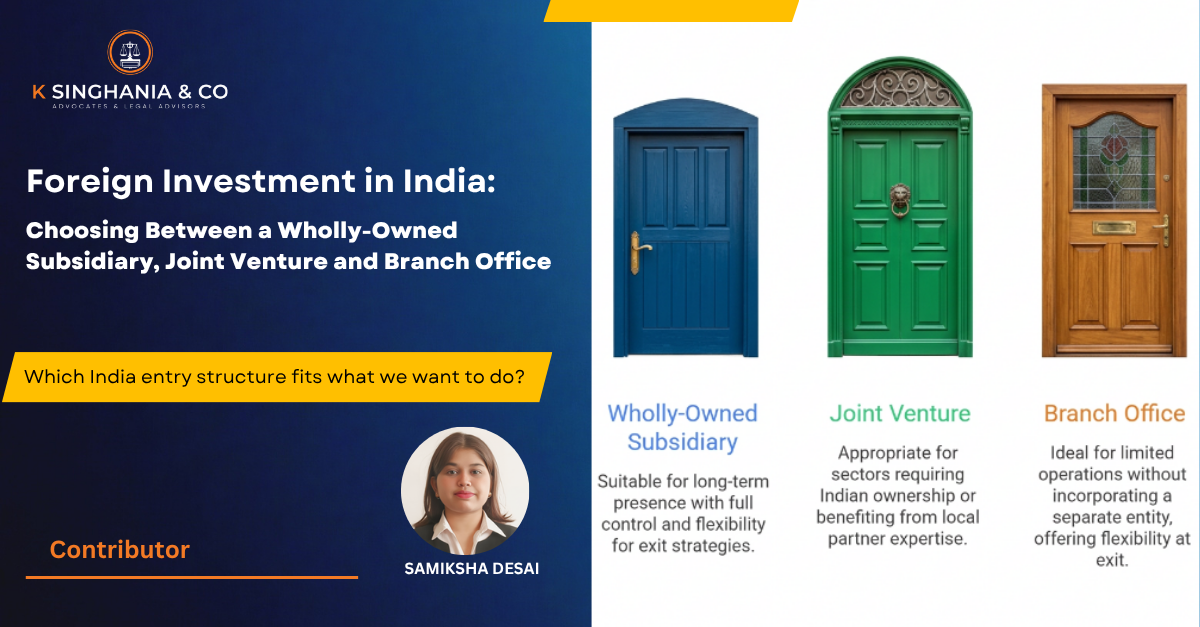
The three primary structures cover a spectrum of India commitment — from full incorporation to a limited operational presence.
|
Feature |
Wholly-Owned Subsidiary |
Joint Venture |
Branch / LO / PO |
|
Legal Form |
Indian company (Companies Act, 2013) |
Indian company (Companies Act, 2013) |
Extension of foreign parent (FEMA) |
|
Ownership |
100% foreign |
Shared with Indian partner |
Foreign parent |
|
FDI Framework |
Sectoral cap + automatic or government route |
Sectoral cap + JV-specific structuring |
RBI approval under FEMA |
|
Permitted Activities |
Any activity permitted for the sector |
Any activity permitted for the sector |
Restricted list of activities |
|
Exit Optionality |
Share sale, IPO, buyback, merger |
Depends on JV terms + share sale mechanics |
Closure and repatriation subject to RBI approval |
|
Regulatory Approval |
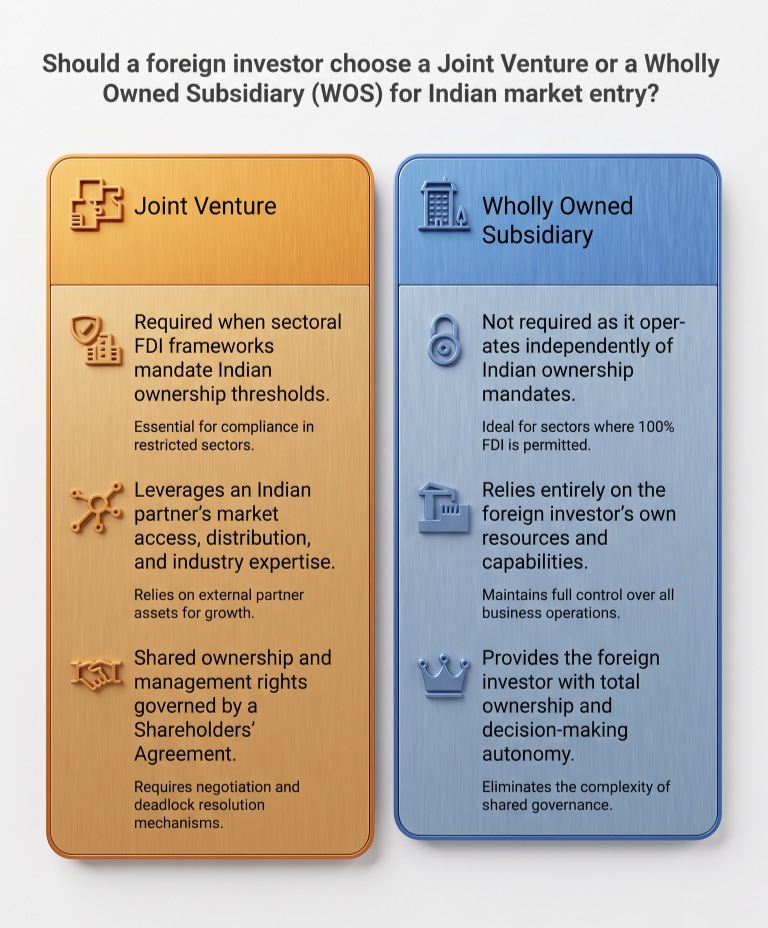
Automatic where 100% FDI permitted |
Automatic or government route depending on sector |
Prior RBI approval required |
Wholly-Owned Subsidiary (WOS)
A WOS is an Indian private or public limited company incorporated under the Companies Act, 2013, with 100% of its share capital held by the foreign parent — directly or through an intermediate holding company. It is a separate legal entity, independently responsible for its own board, corporate governance, and regulatory compliances in India.
When WOS is the Right Choice
- Foreign investor intends to build a substantial India operation with full commercial control
- Target sector permits 100% FDI under the automatic route
- No Indian partner needed for market access, distribution, or regulatory reasons
- Exit strategy contemplates share sale, IPO, or merger
- Investor willing to bear full commercial risk
Sectoral FDI Eligibility
- Manufacturing and most technology activities: 100% FDI, automatic route
- E-commerce marketplace: 100% FDI, automatic route (subject to conditions)
- Insurance: 100% FDI, automatic route (post-2026 liberalisation)
- Defence: up to 74% automatic; beyond 74% requires government approval
- Multi-brand retail: up to 51% under government route only
Joint Venture (JV)
A JV is generally structured as a private or public limited company under the Companies Act, 2013, jointly owned by the foreign investor and one or more Indian partners. Governance is primarily governed by a Shareholders’ Agreement (SHA) read with the Articles of Association, addressing Board composition, reserved matters, transfer restrictions, pre-emption rights, deadlock resolution, and exit arrangements.
When JV is the Right Choice
- Sectoral FDI framework requires Indian ownership above a specified threshold (defence, multi-brand retail, print media, some broadcasting)
- Indian partner brings identifiable value — market access, distribution networks, licences, government relationships, or industry expertise
- Commercial context favours risk-sharing at market entry
- Indian partner brings strategic assets the foreign investor cannot easily acquire independently
Partner Selection is Critical
Partner selection is the load-bearing element of a successful JV. A well-conceived structure can be undermined by poor partner selection; conversely, a strong Indian partner can substantially improve outcomes even where the underlying JV structure is imperfect.
KS&Co Caution
A JV should not be adopted merely because India is perceived as a complex market. Where 100% FDI is permitted and the foreign investor can independently establish its business, a WOS provides greater ownership and decision-making control.
Branch Office, Liaison Office & Project Office
A Branch Office (BO), Liaison Office (LO), or Project Office (PO) is appropriate where the foreign investor wants an operational presence in India without incorporating a separate Indian legal entity. These structures are extensions of the foreign parent under specific FEMA permissions — each with a defined and limited scope of permitted activities, and each requiring RBI approval.
Liaison Office (LO)
Most limited structure. Permitted activities: market research, information gathering, promoting the foreign parent’s products, and coordinating with Indian customers. Cannot undertake commercial or trading activity or earn income in India. All expenses funded by remittances from the foreign parent.
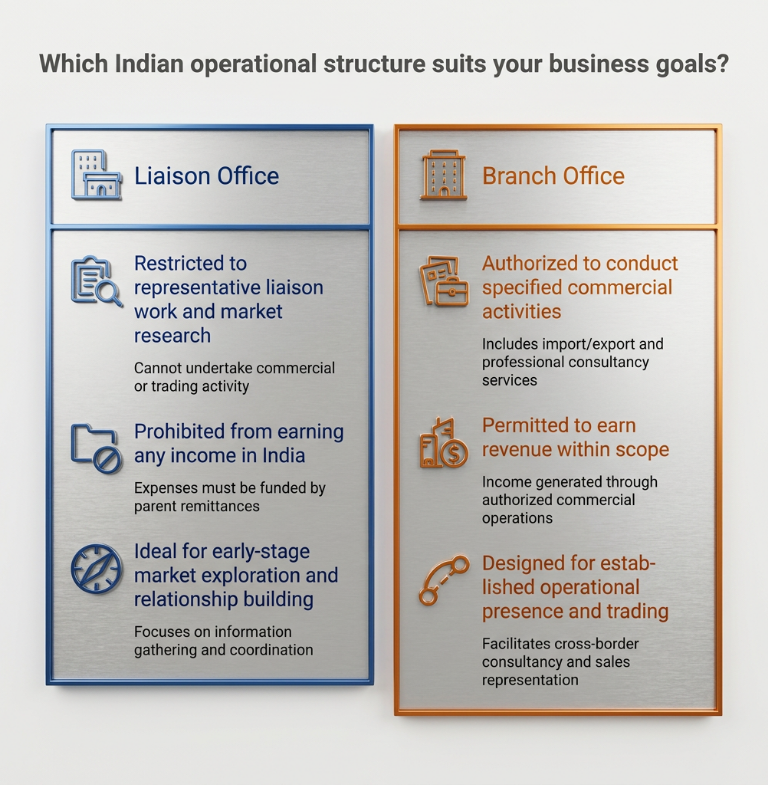 Branch Office (BO)
Broader operational presence. Can undertake export/import, professional or consultancy services, research connected with the foreign parent’s activities, and acting as buying/selling agent. Can earn revenue in India within the permitted activity scope.
Project Office (PO)
Permitted for a specific project awarded to the foreign parent by an Indian entity. Time-limited (duration of the project) and activity-limited (only project-related activities). Common for engineering, construction, and infrastructure projects.
Sectoral FDI Caps, Approval Routes & Press Note 2/2020
The Current Sectoral Landscape
The Indian FDI regime is substantially liberalised, with several sectors permitting up to 100% foreign investment under the automatic route — including manufacturing, technology activities, and insurance (post-2026 amendment). However, sector-specific restrictions remain material:
- Defence: up to 74% automatic; beyond 74% requires government route
- Telecom: up to 100% FDI, subject to security conditions
- Print media: capped at 26%, government approval required
- Multi-brand retail & certain broadcasting: sector-specific caps and conditions apply
The proposed business activity must be mapped against the applicable sectoral entry route, cap, and regulatory conditions at the outset.
Press Note 2/2020 — Land-Border Overlay
Independent of the sectoral cap, Press Note 2/2020 requires prior government approval for FDI from entities of, or citizens of, countries sharing a land border with India — China, Pakistan, Bangladesh, Nepal, Bhutan, Myanmar, and Afghanistan.
The June 2026 FEMA Third Amendment extended this requirement through beneficial ownership — nominee, trust, and multi-layer vehicle structures no longer sidestep the Press Note 2/2020 approval requirement where the ultimate beneficial owner is a citizen of a land-border country.
Tax & Treaty Considerations
The choice of India entry structure directly affects the tax position of the Indian operation and the treaty benefits available on repatriation of profits, dividends, royalties, and capital gains. The Indian corporate tax rate, the Double Taxation Avoidance Agreement (DTAA) network, the Place-of-Effective-Management (POEM) doctrine, and the General Anti-Avoidance Rule (GAAR) all shape the tax outcome.
WOS Tax Position
Subject to Indian corporate taxation. A concessional regime is available to qualifying new manufacturing companies. Dividends, royalties, and certain fees to the foreign parent may attract Indian withholding tax, subject to applicable domestic law and treaty relief.
Treaty Routes — Mauritius, Singapore, Netherlands
Foreign investors have historically used these treaty routes for tax efficiency. Recent legislative and treaty changes have narrowed some benefits. A WOS offers cleaner treaty analysis than a JV, as the treaty position depends only on the foreign parent’s jurisdiction.
POEM & GAAR
POEM rules may result in a foreign-incorporated entity being treated as an Indian tax resident where its effective management is in India. GAAR provisions require particular care where structures are principally designed to obtain treaty or tax advantages.
JV Tax Complexity
A JV requires analysis of the treaty position of each foreign investor and the interaction with the Indian partner’s tax position — different shareholders may be based in different jurisdictions, each with a different treaty position.
Exit Strategy — Think at Entry
Each entry structure has different exit optionality. Foreign investors should think through exit at entry — the structural decision at entry directly determines the exit-day recovery position.
WOS Exit Routes
- Share sale to a strategic or financial buyer
- IPO on an Indian stock exchange (subject to eligibility)
- Share buyback by the WOS
- Merger with another Indian entity
- Liquidation under Companies Act, 2013
JV Exit Routes
- Share sale subject to transfer restrictions (ROFO, ROFR, tag-along, drag-along)
- IPO subject to Indian partner consent and JV agreement mechanics
- Strategic sale of the JV as a whole
- Deadlock resolution — put/call options, buy-out arrangements, or liquidation
BO / LO / PO Closure
- Application to the RBI for closure and repatriation of residual funds
- Compliance with income tax and other regulatory obligations before closure
- Final Annual Activity Certificate and pending regulatory filings
- No separate corporate winding-up process required
Frequently Asked Questions
FAQ
What is the most commonly used structure?
The WOS is the commonly preferred entry structure where 100% FDI is permitted under the automatic route. A JV remains relevant where sectoral caps require Indian participation or where an Indian partner contributes meaningful local expertise, market access, or operational capabilities.
Can a foreign company operate through a Branch Office?
Yes, subject to RBI/FEMA approvals and restrictions on permitted activities. A BO cannot undertake general trading or manufacturing. The choice between a BO and WOS depends on the nature, scope, and expected duration of operations.
What are the tax implications of WOS vs. JV?
Both are Indian companies subject to Indian corporate tax. The key difference arises at the shareholder level — treaty benefits, GAAR applicability, and withholding tax treatment vary depending on the foreign shareholder’s jurisdiction and the ownership structure.
How long does incorporation take?
A WOS or JV can typically be incorporated within 2–4 weeks where documents are available and no regulatory delays arise. Where the government approval route applies, the overall timeline may extend by several months.
About K Singhania & Co
K Singhania & Co is a full-service commercial law firm headquartered in Mumbai, advising foreign companies, family offices, and international investors on India-facing corporate, regulatory, and litigation matters.
The firm’s Corporate and Market Entry practice handles India entry structuring, FEMA compliance, cross-border investment structuring, JV and WOS set-up, branch and liaison office establishment, FDI approvals, tax and treaty structuring, and MCA compliance for international clients across Europe, the US, Southeast Asia, and the Middle East.