The Dispute Newsletter of July 2025 aims to highlight how Courts have reaffirmed on the limited scope of judicial intervention under Section 11 of the Arbitration and Conciliation Act, 1996. The Supreme Court and various High Courts have consistently held that at the stage of appointing an arbitrator, courts must confine themselves to examining the existence of an arbitration agreement, without venturing into issues like arbitrability, limitation, or res judicata. These rulings reinforce the principle that such substantive matters are to be determined by the arbitral tribunal, thereby upholding the autonomy and efficiency of the arbitration process.
Office for Alternative Architecture v. Ircon Infrastructure & Services Ltd. – Supreme Court of India
Citation: 2025 SCC OnLine SC 1098
Date of Judgement: 13th May 2025
Forum: Supreme Court of India
Ruling: While deciding an application under Section 11 of the Arbitration and Conciliation Act, 1996, courts can’t bisect Claims as Arbitrable & Non-Arbitrable
Facts: Office for Alternative Architecture entered into a contract with Ircon Infrastructure and Services Ltd. for a construction project governed by an agreement containing an arbitration clause. Disputes arose between the parties, leading the appellant to initiate arbitration proceedings and file a petition under Section 11 of the Arbitration and Conciliation Act, 1996, seeking appointment of an arbitral tribunal. The Delhi High Court, while appointing the tribunal, partially allowed the request but excluded certain claims as non-arbitrable or falling under excepted matters pursuant to clauses of the contract . Aggrieved by the High Court’s exclusion of these claims at the referral stage itself, Office for Alternative Architecture challenged the decision before the Supreme Court, contending that the arbitrability of claims should be left for determination by the arbitral tribunal.
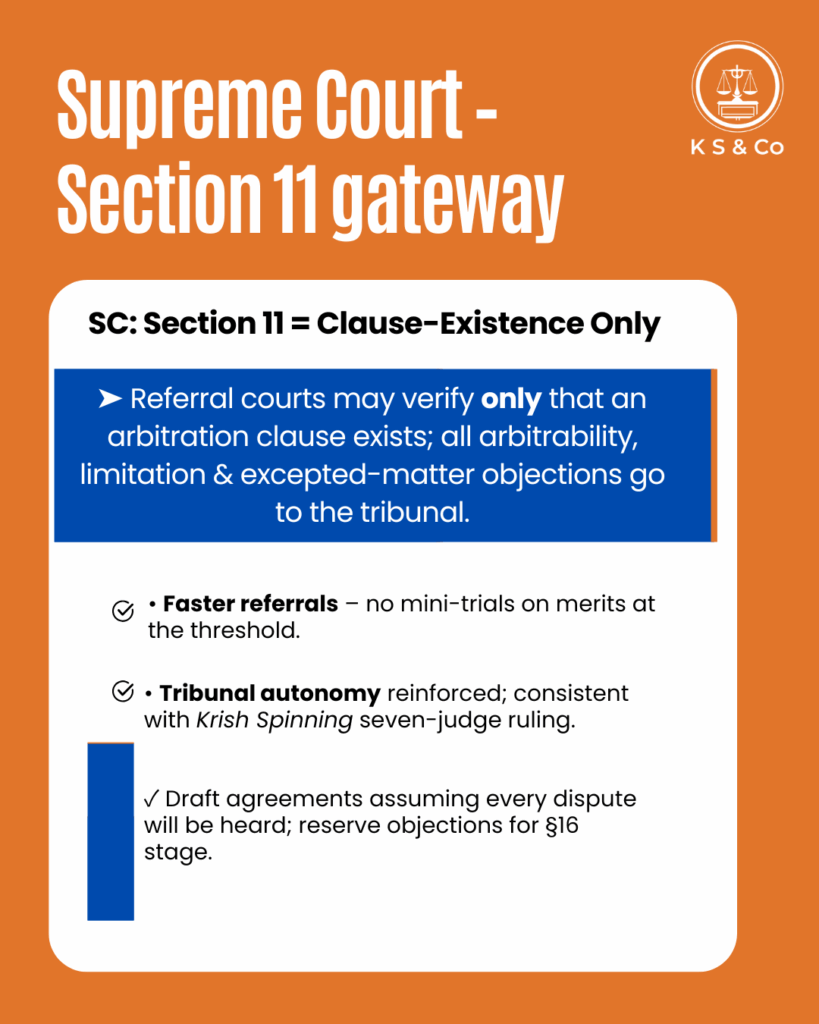
Issues: Whether a court, while deciding an application under Section 11 of the Arbitration Act, has the jurisdiction to examine and exclude specific claims as non-arbitrable or falling within excepted matters, or whether such questions should be left to be decided by the arbitral tribunal.
Judgement & Reasoning: It was held that a referral court’s jurisdiction under Section 11 of the Arbitration and Conciliation Act is limited to verifying the existence of an arbitration agreement. It does not extend to deciding whether specific claims are arbitrable or fall under excepted matters in the contract. The Court noted that Section 11(6A), introduced by the 2015 Amendment, mandates that courts should only examine the existence of the agreement, not the merits or arbitrability of claims. Although Section 11(6A) was omitted in the 2019 Amendment, it remains operative due to an unnotified omission. The Court cited the seven-Judge bench in In Re: Interplay Between Arbitration Agreements and its recent ruling in SBI General Insurance Co. Ltd. v. Krish Spinning, reaffirming that even non-arbitrable or frivolous claims should be left for the arbitral tribunal to decide under Section 16 of the Act.
The Court distinguished previous rulings, like Emaar India Ltd. v. Tarun Aggarwal Projects LLP, by noting they were from smaller benches and didn’t override the larger bench’s clear stance. It concluded that the Delhi High Court exceeded its jurisdiction by excluding claims, as such decisions should lie with the arbitral tribunal. The Court set aside the High Court’s order and clarified that Ircon Infrastructure could raise objections about arbitrability before the tribunal, which would decide the issue independently.
K S&Co Comments:
The Supreme Court’s judgment offers a clear and important clarification regarding the scope of a court’s role when deciding an application under Section 11 of the Arbitration Act. The Court reaffirmed that the referral court’s inquiry should be confined to verifying the existence of an arbitration agreement and should not extend to determining whether specific claims are arbitrable or fall within excepted matters in the contract. This judgment effectively upholds the principle that issues regarding the arbitrability of claims, as well as whether certain claims fall within the scope of the arbitration agreement, are matters for the arbitral tribunal to decide, not the court. This ruling is crucial because it reinforces the autonomy and authority of the arbitral tribunal in determining the scope of its jurisdiction. The Court’s emphasis on the limited role of the court at the Section 11 stage is consistent with the broader objective of the Arbitration and Conciliation Act, which is to minimize judicial interference in the arbitral process. By ruling that arbitrability should be determined by the tribunal and not the court at the threshold, the Court has ensured that arbitration remains a flexible and efficient dispute resolution mechanism, free from unnecessary delays caused by judicial intervention.
Gayatri Balasamy v. ISG Novasoft Technologies Ltd. – Supreme Court of India
Citation: 2025 SCC OnLine SC 986
Date of Judgement: 30th April 2025
Forum: Supreme Court of India
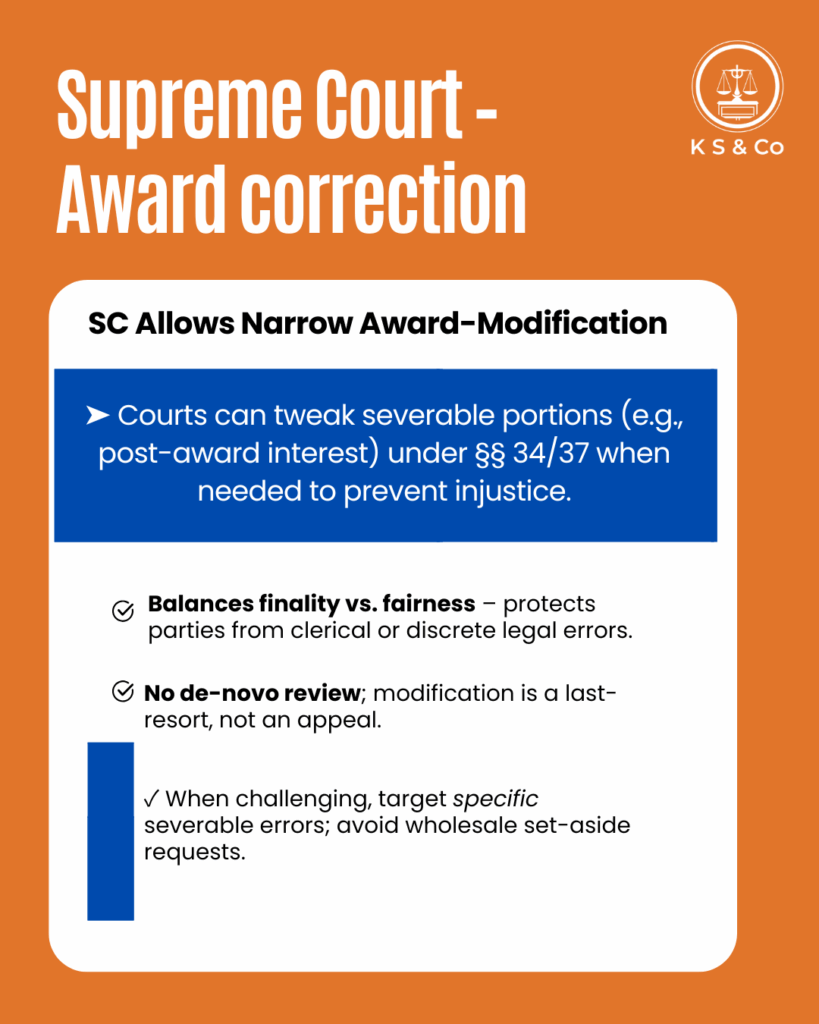
Ruling: Courts have a limited power to modify an arbitral award in specific circumstances under Sections 34 and 37 of the Arbitration Act.
Facts: The dispute arose in the context of whether Indian courts could modify arbitral awards under the 1996 Act. The issue reached the Supreme Court through multiple Special Leave Petitions, including the one filed in Gayatri Balasamy v. ISG Novasoft Technologies Ltd.. The Petitioner (Gayatri) was an employee of ISG Novasoft Technologies Ltd., who later resigned and a dispute arose regarding payment of dues. The initial award was in her favour where the respondent was asked to pay a certain amount to her. The respondent aggrieved, filed an application under Section 34 of the Act and the same was dismissed. Aggrieved they filed an application under Section 37 of the Act, where the court changed the amount mentioned in the award. Dissatisfied with this Gayatri approached the Supreme court, where a broader legal question was raised: Does an Indian court have the power to modify an arbitral award under Sections 34 or 37 of the Arbitration and Conciliation Act, 1996? The Supreme Court heard Gayatri’s appeal as part of a batch of cases addressing this legal issue.
 Issues:
- Whether the powers of the Court under Sections 34 and 37 of the Arbitration and Conciliation Act 1996 will include the power to modify an arbitral award? If the power to modify the award is available, whether such power can be exercised only where the award is severable, and a part thereof can be modified?
- Whether the power to set aside an award under Section 34 of the Act, being a larger power, will include the power to modify an arbitral award and if so, to what extent?
- Whether the power to modify an award can be read into the power to set aside an award under Section 34 of the Act?
Judgement & Reasoning: The Supreme Court analyzed the Arbitration and Conciliation Act, 1996, and judicial precedents, distinguishing between the power to “set aside” and “modify” an award. While the Act doesn’t explicitly allow modification, the Court recognized a limited scope for modification based on the doctrine of severability. It held that if invalid parts of an award can be separated, courts may partially set aside or modify the award. Courts can also correct clerical or typographical errors without addressing the merits. The Court allowed modification of post-award interest under Section 31(7)(b), emphasizing that this does not constitute appellate review but prevents injustice and avoids protracted litigation. It also invoked Article 142 of the Constitution, noting that while the power to modify awards exists in exceptional cases to do complete justice, it should be exercised with restraint.
Rejecting a rigid interpretation of Section 34, the Court stressed that a purposive interpretation must guide arbitration law. Citing international practices, it concluded that modification is an inherent part of a court’s jurisdiction under Section 34, provided it is limited, narrowly tailored, and non-appellate.
K S&Co Comments:
The Court clarified that although the Arbitration Act does not expressly permit modification of arbitral awards, limited intervention is allowed when parts of the award are severable. Relying on the doctrine of severability, the Court held that errors in discrete portions such as post-award interest under Section 31(7)(b) can be corrected without disturbing the entire award. This approach maintains the balance between respecting arbitral autonomy and ensuring justice. Importantly, the Court invoked Article 142 to allow such modification but emphasized that this power must be used sparingly and not as a substitute for appellate review. The judgment reinforces that arbitration should remain efficient and final, but not at the cost of fairness. It reflects a purposive interpretation of the law, allowing courts to step in only to prevent injustice arising from technical or procedural lapses.
Hindustan Construction Co. Ltd. v. Indian Strategic Petroleum Reserves Ltd.
Citation: 2025 SCC OnLine Del 3661
Date of Judgement: 7th May 2025
Forum: Delhi High Court
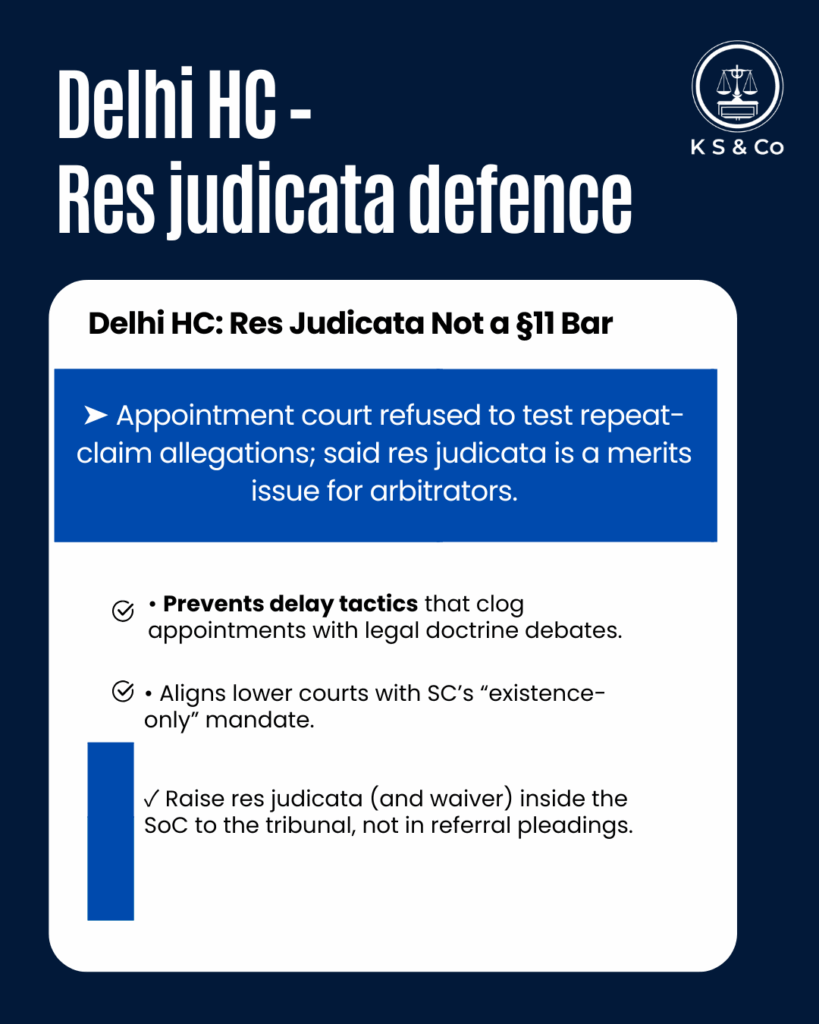
Ruling: While deciding an application for appointment of Arbitrator, the court cannot examine whether a claim is barred by res judicata.
Facts: Hindustan Construction Company Ltd. was awarded a contract by Indian Strategic Petroleum Reserves Ltd. in 2009 for civil works involving underground rock caverns for strategic crude oil storage in Padur, Karnataka, with a contract value exceeding ₹374 crores. Disputes arose over delays, financial claims, and contract execution, leading to arbitration in 2017, which culminated in an arbitral award in June 2021 awarding over ₹35.99 crores plus interest to Hindustan Construction. Both parties filed petitions challenging different parts of the award. On 2 August 2024, the Delhi High Court, with both parties’ consent, set aside the award to the extent it granted payment to the petitioner, while disposing of the petitioner’s challenge to the partial disallowance of its claims as infructuous. Subsequently, Hindustan Construction invoked arbitration afresh in September 2024, proposing three independent arbitrators. The respondent refused to proceed, asserting that the petitioner was estopped from raising the same claims again, citing principles of res judicata and waiver, prompting the petitioner to file the present Section 11 petition.
 Issues: Whether, in a petition under Section 11 of the Arbitration Act seeking appointment of an arbitrator, the High Court could decide if the petitioner’s claims were barred by res judicata due to prior proceedings and the consent order disposing of the earlier arbitral award.
Judgement & Reasoning: The court ruled that in Section 11 proceedings under the Arbitration and Conciliation Act, the Court’s role is limited to verifying the existence of an arbitration agreement and determining whether the request for arbitration is time-barred. The Court cannot address complex legal defences like res judicata, waiver, or estoppel, as these matters are for the arbitral tribunal to decide. Referring to the Supreme Court’s decision in Indian Oil Corporation Ltd. v. SPS Engineering Ltd., the Court noted that determining res judicata requires a detailed analysis of pleadings, claims, and findings, which is beyond the scope of Section 11 proceedings.
The Court also clarified that the respondent’s argument, claiming Hindustan Construction had agreed to set aside the earlier award, was a substantive issue regarding the maintainability of claims, not the existence of the arbitration agreement. This, too, was for the arbitral tribunal to decide. The Court emphasized that Section 11 proceedings are not meant to resolve substantive legal issues, as this would undermine the arbitration process. It left all issues, including res judicata and the impact of the prior consent order, to the tribunal, without expressing any opinion on the merits of the claims or defences.
K S&Co Comments:
This judgement offers important insights into the role of the Court in Section 11 proceedings under the Arbitration and Conciliation Act, 1996. The Court rightly emphasized that its function in these proceedings is confined to a limited scope, which essentially involves verifying the existence of an arbitration agreement and ensuring that the request for arbitration is not time-barred. This decision aligns with the principle that Section 11 proceedings should not be used as a forum to address complex legal defences, such as res judicata, waiver, or estoppel, which often require detailed factual analysis and legal reasoning—matters more suited to be dealt with by the arbitral tribunal. The Court’s clear demarcation of responsibilities between the judicial authority and the arbitral tribunal is significant in preserving the integrity and autonomy of the arbitration process. The Court’s emphasis on resolving substantive issues, including whether res judicata applies or not, at the level of the tribunal, reinforces the idea that arbitration is a forum for a full hearing on the merits. This principle ensures that parties are not prematurely restricted from raising legitimate claims, simply because a procedural or substantive issue arises
GRN Constructions (P) Ltd. v. Singareni Collieries Co. Ltd.
Citation: 2025 SCC OnLine TS 282
Date of Judgement: 2nd May 2025
Forum: Telangana High Court
Ruling:The Hon’ble High Court held that it us Unfair To Presume That Plea Of Limitation Can’t Be Adjudicated By Arbitrator, Court under section 11 Must Not Conduct Roving Inquiry:
Facts: GRN Constructions Pvt. Ltd. was awarded a mining contract by Singareni Collieries through a firm order dated 19 September 2016 for selective coal extraction works valued at over ₹52.64 crores. After completion of the work and submission of final bills, disputes arose over financial adjustments, including claims for recovery by Singareni amounting to ₹1,83,64,150/-, which included ₹32,78,390/- allegedly towards the costs of explosives. GRN Constructions contested this amount as unjustified and contrary to the contract. While initially obtaining interim protection through a Section 9 petition to restrain invocation of its bank guarantee, GRN ultimately paid the demanded sum under protest and withdrew the interim proceedings, reserving its right to arbitrate the dispute regarding excess recoveries. Upon initiating arbitration and proposing an arbitrator, Singareni refused to proceed, contending the claims were time-barred under Clause 1.21 of the contract and that the arbitration request was not validly invoked within 120 days of the dispute.
Issues: 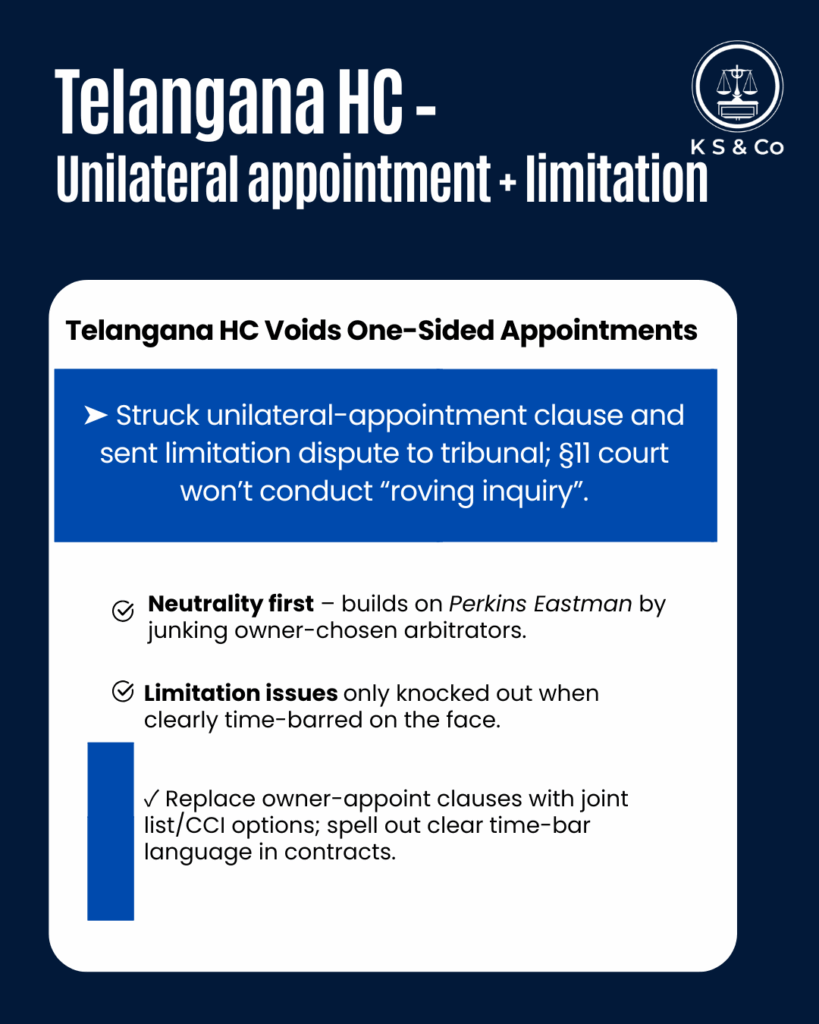
- Whether the arbitration application was barred by limitation for not being filed within 120 days as stipulated in the arbitration clause?
- Whether the unilateral appointment mechanism in the contract was legally valid.
- Whether the dispute over the ₹32,78,390/- recovery was arbitrable.
Judgement & Reasoning: It was ruled that the arbitration application could not be dismissed on limitation grounds at the Section 11 stage, as this requires a factual inquiry beyond the court’s limited role. The Court referred to Vidya Drolia v. Durga Trading Corporation and Aslam Ismail Khan Deshmukh v. ASAP Fluids Pvt. Ltd, emphasizing that limitation issues should be decided by the arbitral tribunal unless the claims are clearly time-barred. Ongoing negotiations between the parties indicated that the dispute was still active, and limitation could not be determined without further evidence.
The Court also invalidated the unilateral appointment clause, citing Perkins Eastman Architects which held that such clauses violate the neutrality required in arbitration. The clause giving Singareni’s Chairman & Managing Director exclusive power to appoint the arbitrator was deemed unenforceable.
Finally, the Court noted that GRN Constructions’ continued work with Singareni and Singareni’s attempt to recover disputed amounts indicated a live dispute. The Court concluded that the recovery issue was arbitrable and appointed Sri Mangari Rajender as sole arbitrator to resolve all issues, including limitation, merits, and defences.
K S&Co Comments:
The Telangana High Court reaffirmed the limited scope of judicial intervention in arbitration, particularly regarding limitation and arbitrator appointments. It held that limitation issues should be decided by the arbitral tribunal unless the claim is clearly time-barred, and that a Section 11 application is not the stage for factual inquiries. The Court also struck down a unilateral appointment clause that gave one party exclusive power to appoint the arbitrator, citing concerns over neutrality and fairness. This judgment reinforces arbitration’s core principles such as efficiency, impartiality, and minimal court interference. In the interest of justice and to save time, the court appointed neutral arbitrator as per law, as unilateral appointment is not legally valid. But keeping in view that parties wanted to settle through arbitration.