What are the key pharmaceutical IP developments in India in 2026?
Quick Answer:
The developments in Q3 and Q4 of 2026 produced three material shifts in India’s pharmaceutical IP framework. The Delhi High Court’s ruling in Array BioPharma Inc v Deputy Controller of Patents and Designs (23 July 2026, 2026:DHC:5856) clarified that Section 3(d) does not apply to combinations of independent active pharmaceutical ingredients, that a combination patent will not automatically be rejected as a “method of treatment” under Section 3(i) merely because the claim references sequential administration, and that Controllers invoking Section 3(d) must identify the “known compound” of which the claimed invention is allegedly a derivative.
The Supreme Court is examining a constitutional challenge to the 20-year patent term calculated from the filing date rather than the grant date (notice issued in Gunjan Sinha v Union of India in 2026 by Justices Pamidighantam Sri Narasimha and Alok Aradhe) — the outcome will shape the effective life of every Indian pharma patent. And Indian trademark enforcement in the pharma sector has sharpened around the heightened-caution line, with both Nava Healthcare v Antex Pharma (Delhi HC, 24 July 2026) and the Hahnemann DIGESTO PLUS Division Bench ruling (early September 2026) reinforcing when deceptive similarity will and will not sustain injunctive relief.
For foreign pharma counsel advising on India-facing matters, the practical consequence is that patent prosecution, trademark enforcement, and the pending patent term question all require fresh audit heading into the Q1 2027 cycle.
Why this matters for foreign pharma counsel
For foreign pharma counsel advising Big Pharma clients, biosimilar developers, patent applicants in India’s Patent Office, and foreign pharma brand owners managing Indian trademark portfolios, India’s Q3-Q4 2026 developments move the operational baseline in three directions. First, Section 3(d) is being applied with sharper evidentiary discipline — refusals are being set aside where the Controller has failed to analyse the enhanced therapeutic efficacy point.
Second, the enforceable patent term is itself under constitutional scrutiny — if the Supreme Court strikes down the filing-date calculation, foreign patent-holders whose Indian grants were materially delayed may obtain extended effective protection. Third, pharma trademark enforcement operates under a heightened-caution line that distinguishes genuinely deceptive similarity from descriptive-term overlap.
Together, these three shifts determine whether a foreign pharma company’s Indian patent will stand, when it will expire, and whether its Indian brand will attract enforcement.
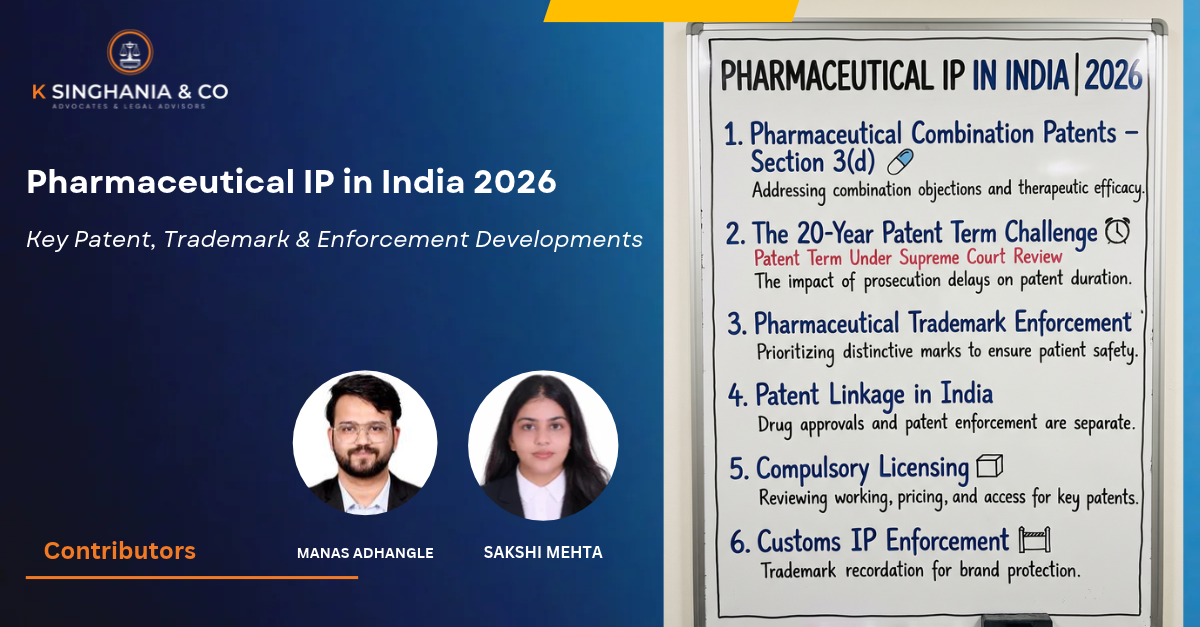
The six sections below cover each development with the specific citations foreign counsel should reference.
Section 1: How has the Delhi High Court clarified Section 3(d) and Section 3(i) for pharmaceutical combination patents?
Bottom line. The Delhi High Court’s ruling in Array BioPharma Inc v Deputy Controller of Patents and Designs (23 July 2026, neutral citation 2026:DHC:5856, Case No. C.A. (COMM.IPD-PAT) 37/2023) is a significant decision concerning Indian pharmaceutical patent law, with important implications for patent prosecution for foreign pharma counsel. The Court held three things that materially affect pharmaceutical combination patent prosecution: Section 3(d) of the Patents Act, 1970 (the provision governing new forms of a known substance) does not apply to combinations of independent active pharmaceutical ingredients; Section 3(i) (the method-of-treatment exclusion) does not automatically defeat a combination claim merely because the claim references sequential administration; and where Section 3(d) is actually invoked, the Controller must specifically identify the “known compound” of which the claimed invention is allegedly a derivative. The Court set aside the Controller’s refusal and remanded the application for fresh consideration within six months.
The Array BioPharma ruling (23 July 2026). The application concerned a pharmaceutical combination for cancer therapy. The Deputy Controller had refused the application on three grounds — Section 3(d), Section 3(i), and lack of inventive step. The Delhi High Court set aside each ground:
- Section 3(d). The Court held that Section 3(d), which addresses certain new form of a known substance to demonstrate enhanced therapeutic efficacy, is directed at salt forms, polymorphs, and derivatives of a single known compound — not at combinations of two or more independent active pharmaceutical ingredients (APIs). The court further emphasised the need for the Controller specifically identify the “known compound” and analyse the enhanced therapeutic efficacy data, even if Section 3(d) is invoked adequately.
- Section 3(i). The Court held that a pharmaceutical combination claim does not automatically fall within the scope of “method of treatment” under Section 3(i) merely because the claim describes sequential administration. The Section 3(i) exclusion is directed at claims that are, in substance, methods of medical treatment — not at product claims that happen to describe how the product is administered.
- Inventive step. The Court found that the Controller’s inventive step objection was not supported by prior art that disclosed the specific combination, and that the Controller had not reasoned the “motivation to combine” standard adequately.
The matter was remanded to the Controller for de novo consideration within six months, with the direction to the Controller that the application must be decided on merits, free of the earlier flawed reasoning.
The Grains Research and Development Corp v Assistant Controller ruling (23 February 2026). A separate Delhi High Court ruling earlier in 2026 held that Section 3(d) objections must be supported by independent analysis of the “known substance or process” being compared, and that the Controller must identify and reason out the specific statutory requirements. Any refusals that fails this standard will be set aside on appeal.
The Syngenta v Controller ruling (4 May 2026). In an agrochemical patent context, the Delhi High Court held that “efficacy” under Section 3(d) is not confined to therapeutic efficacy — for agrochemicals, functional and practical advantages such as enhanced stability and improved field performance can meet the efficacy threshold. The pharmaceutical heartland of Section 3(d) continues to apply the therapeutic-efficacy standard established in Novartis AG v Union of India (2013).
What foreign pharma counsel should do. The practical consequences for foreign pharma counsel are three. For combination patent applications in prosecution before the Indian Patent Office, respond to Section 3(d) objections by framing the claim as a combination of independent APIs — Array BioPharma is the leading precedent against the application of Section 3(d) to such combinations. For claims that describe sequential or combination administration, resist any Section 3(i) method-of-treatment objection by distinguishing product claims from treatment-method claims — again, Array BioPharma applies. For granted Indian patents where enforcement is contemplated, the Array BioPharma framework strengthens the position in validity challenges.
Section 2: What is the Supreme Court’s pending challenge to the 20-year patent term calculation?
Bottom line. The Supreme Court is examining a constitutional challenge to the statutory provision calculating India’s 20-year patent term from the filing date, rather than the grant date. In September 2026, a bench of Justices Narasimha and Aradhe in Gunjan Sinha@ Kanishk Sinha v. The Union of India (SLP (C) Diary No. 43127/2026), issued notice on a special leave petition arising from a seven-year patent prosecution delay and appointed an amicus curiae Kruttika Vijay, to assist the Court. If the Court accepts the challenge, the effective life of every Indian pharma patent that suffered prosecution delay would extend.
The constitutional question. The challenge contends that the current statutory framework — under which the 20-year term runs from the date of filing — effectively strips the patent holder of the years lost to administrative delay in the Patent Office. The petition argues this violates Article 14 (equality before the law) and Article 300A (property rights) of the Constitution of India where the Patent Office is itself the cause of the lost years.
Why this matters for pharma specifically. Pharmaceutical patents are the single most delay-sensitive category of Indian patents. The typical Indian pharma patent takes 5-10 years from filing to grant, often longer where Section 3(d) or Section 3(i) objections prolong prosecution. A foreign pharma major with a 10-year grant delay effectively has 10 years of enforceable patent life, not 20. If the Supreme Court accepts the challenge, the available remedy — most likely a term-extension mechanism tied to prosecution delay — would materially increase the realised value of every Indian pharma patent that suffered delay.
Timeline and status. Supreme Court notice issued; amicus curiae appointed; the matter is at a pre-merits stage. A final ruling is unlikely before Q2-Q3 2027, but foreign pharma counsel should monitor the hearing calendar and the amicus curiae’s submissions as these will shape the eventual framework.
What foreign pharma counsel should do. For foreign pharma clients with Indian patents that suffered material prosecution delay (five years or more between filing and grant), the sensible step is to document the delay chronology now — Patent Office hearings, First Examination Report dates, response times, pre-grant opposition history. If the Supreme Court ultimately grants a term-extension framework, that documentation will be the evidentiary basis of any extension application.