

Quick Answer: Does CSR apply to foreign-owned companies in India?
Yes. An Indian subsidiary of a foreign company is subject to CSR requirements under Section 135 of the Companies Act, 2013 if it meets the prescribed financial thresholds. Covered companies must calculate their CSR obligations using the statutory net profit methodology, spend on eligible activities and comply with applicable governance, reporting and unspent-amount requirements.
Overview 
India treats corporate giving as a legal duty, not a voluntary gesture. If your Indian subsidiary meets any one of the three prescribed financial thresholds, it must spend 2% of its three-year average profit on causes from a government-approved list under Corporate Social Responsibility (“CSR”) rules. The next compliance deadline is close, with the financial year ending on 31st March 2027. The year has also brought something new. Since 27th May 2026, up to 10% of the CSR spend may be routed through Zero Coupon Zero Principal (“ZCZP”) instruments on India’s Social Stock Exchange (“SSE”). This article explains who is covered, how the amount is worked out, where the money can be spent, and how to stay compliant.
Why does CSR compliance matter for foreign-owned Indian subsidiaries right now?
In India, Corporate Social Responsibility is a legal obligation under Section 135 of the Companies Act, 2013. It applies equally to every company meeting the thresholds, including Indian subsidiaries of foreign parent companies.
Three features set the Indian framework apart from CSR rules in other jurisdictions:
The 2% spending amount is calculated on a statutorily defined net profit under Section 198, not on Profit After Tax (PAT) reported in standard group accounts.
The list of permitted activities is fixed by law in Schedule VII — companies cannot determine their own CSR categories.
Non-compliance attracts civil monetary penalties on the company and its officers in default, enforced through the Ministry of Corporate Affairs (MCA), with the quantum tied to the shortfall.
For foreign-owned subsidiaries approaching the 31 March 2027 year-end, the recurring questions are whether the obligation is triggered, how much must be spent, which activities and agencies can be used, and what happens to unspent amounts. For FY 2026-27, there is also one new question — whether to use the Zero Coupon Zero Principal (ZCZP) route, a Social Stock Exchange pathway that did not exist before 27 May 2026.
Section 1: Which Indian subsidiaries must follow the CSR rules?
Section 135(1) of the Companies Act, 2013 applies to any Indian subsidiary of a foreign group that, in the immediately preceding financial year, had:
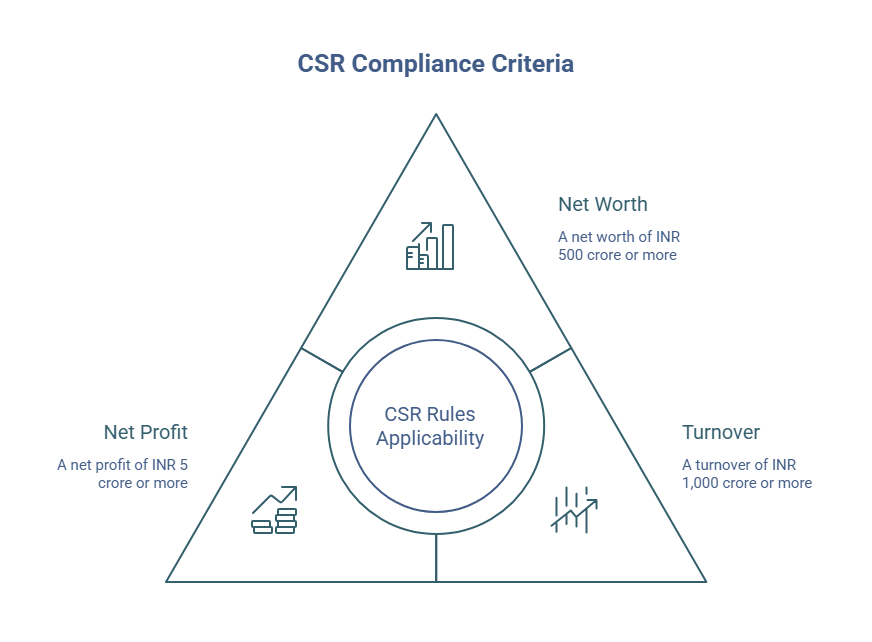
Net Worth
INR 500 crore or more
Turnover
INR 1,000 crore or more
Net Profit
INR 5 crore or more
The three thresholds work independently. A company that crosses any one of them is covered, even if it stays below the other two. Foreign ownership does not change the test — only the Indian company’s own financial data is assessed.
The CSR applicability test is assessed annually with reference to the immediately preceding financial year. Where an Indian subsidiary meets any one of the prescribed thresholds, the Board must ensure compliance with the applicable CSR requirements, including the spending obligation and constitution of a CSR Committee, where required. For subsidiaries whose financial performance fluctuates from year to year, advance planning remains important.
Section 2: How much must be spent on CSR under Section 135?
Section 135(5) requires the Board to ensure the company spends, in every financial year, at least 2% of the average net profit of the three immediately preceding financial years, in line with its CSR policy. If the company has not completed three financial years since incorporation, the average is calculated over the completed years.
The following are excluded from Section 198 net profit even where they appear in the P&L:
- Unrealised gains and notional gains
- Profits arising from the revaluation of assets
- Profits from the sale of immovable or fixed property or investments (unless the company’s ordinary business is the trading of such assets)
- Certain government subsidies received for capital purposes
The statutory auditor should prepare a reconciliation statement for each of the three preceding financial years, strictly applying the Section 198 inclusions and exclusions, to arrive at the correct average.
Section 3: Which activities count as CSR under Schedule VII?
Only the activities listed in Schedule VII of the Companies Act, 2013 qualify as CSR. Schedule VII is a fixed list that covers healthcare, education, gender equality, the environment, national funds, rural and slum development, disaster management, and subscription to ZCZP instruments on the Social Stock Exchange (“SSE”).
Schedule VII is read broadly but remains a closed list. Its main heads:
Healthcare and social welfare
Hunger, poverty, malnutrition, preventive healthcare and sanitation (including the Swachh Bharat Kosh), safe drinking water.
Education and livelihood
Education including special education, vocational skills for vulnerable groups, livelihood enhancement projects.
Equality
Gender equality and women’s empowerment, facilities for senior citizens and orphans, measures reducing inequalities for the backward class.
Environment, heritage and sports
Ecological balance, flora and fauna protection, Clean Ganga Fund, Rural/National/Olympic sports.
National funds and R&D
Specified Central Government funds (PM CARES Fund, Prime Minister’s National Relief Fund) and government-funded incubators or R&D projects.
Development and disaster management
Rural development, slum development, disaster relief, rehabilitation, reconstruction.
ZCZP subscription
Zero Coupon Zero Principal instruments on the Social Stock Exchange (see Section 5).
Support for armed forces
Benefits for Central Armed Police Forces (CAPF) and Central Para Military Forces (CPMF) veterans and their dependents.
The negative list
Specifically excluded from CSR even where socially beneficial:
- Activities in the company’s normal course of business.
- Activities that benefit only (or significantly) the company’s own employees and their families.
- Activities carried out outside India.
- Direct or indirect contributions to political parties.
- Sponsorship aimed at gaining marketing benefits for the company’s products or services.
- Activities already required under any other Indian law.
Section 4: What governance does Section 135 require at Board level?
A CSR Committee is mandatory for a company whose mandatory CSR spend is more than INR 50 lakh in the financial year. Where the mandatory spend is INR 50 lakh or less, the company’s existing Board of Directors performs the functions of the Committee. However, this exemption does not apply if the company has undertaken an “ongoing project.”
Composition of the CSR Committee
A CSR Committee of the Board must have three or more directors, and at least one of them must be an Independent Director. Two relaxations apply:
- Unlisted public companies and private companies that are not otherwise required to appoint an Independent Director under Section 149(4) may form the CSR Committee with two or more directors, without an Independent Director.
- A private company that has only two directors on its Board must form its CSR Committee with those two directors.
The INR 50 lakh exemption
Section 135(9) exempts a company with mandatory CSR spend of INR 50 lakh or less from forming a CSR Committee; the Board performs the Committee’s functions directly. The exemption is nullified where the company has an ongoing project generating balances in the Unspent CSR Account under Section 135(6), because multi-year project tracking requires formal committee oversight.
Duties of the CSR Committee (or of the Board where there is no Committee)
Formulate and recommend the CSR Policy to the Board, listing activities from Schedule VII; recommend the CSR spend; monitor implementation and establish a transparent control mechanism; and formulate the Annual Action Plan — the working document listing approved projects, modalities, timelines, and monitoring arrangements. Unspent-amount transfer and project-tracking mechanics are covered in Section 6 below.
Meetings and quorum
The Companies Act does not prescribe the number of CSR Committee meetings. Secretarial Standard 1 (SS-1) issued by the Institute of Company Secretaries of India provides that Board committees “shall meet as often as necessary” and that all members of a committee must be present to form the quorum unless the Act, the Articles of Association, or the Board provides otherwise.
Section 5: What is the new Zero Coupon Zero Principal (ZCZP) pathway?
From 27th May 2026, a company can route up to 10% of its mandatory CSR spend through subscription to Zero Coupon Zero Principal (ZCZP) instruments. These instruments are issued by Not-For-Profit Organizations (NPOs) that are listed on the Social Stock Exchange (“SSE”) segment of a recognized stock exchange. The pathway was introduced by notifications G.S.R. 415(E) and G.S.R. 416(E) of the Ministry of Corporate Affairs (MCA). These notifications inserted Rule 4A into the Companies (Corporate Social Responsibility Policy) Rules, 2014 and added Item (xiii) to Schedule VII of the Companies Act, 2013.
What is a ZCZP instrument?
A ZCZP is an instrument issued by an NPO that is registered on the SSE. It pays no coupon (interest) and does not return the principal (the original amount invested) to the subscriber at maturity. This means that the subscription amount is, in effect, a grant to the NPO. The grant is routed through a listed instrument, which is subject to disclosure and governance requirements prescribed by the Securities and Exchange Board of India (SEBI), the regulator of India’s securities markets.
The 10% cap
The amount spent through ZCZP instruments cannot be more than 10% of the company’s total CSR expenditure in a financial year. For example, if a subsidiary has a mandatory CSR obligation of INR 16 lakh, up to INR 1.6 lakh can be routed through ZCZPs.
Project duration limit
The projects of an NPO that are funded through ZCZPs must have a duration of not more than three succeeding financial years from the date of issue of such instrument.
Exemption from impact assessment
A company that subscribes to ZCZPs is relieved of the mandatory impact assessment for the specific projects funded through those instruments, in cases where an impact assessment would otherwise apply as per Rule 4A(2) of the Companies (CSR Policy) Amendment Rules, 2026. An impact assessment is an evaluation of the social results of a project.
Unspent funds when the project ends
Any amount that remains unspent when a ZCZP-funded project ends must be transferred to a Schedule VII fund (a fund specified in Schedule VII). The company must also file a compliance report with SEBI in the prescribed form.
Eligibility for the pathway
For a subscription to count as CSR, two conditions must be met. The issuing NPO must be registered on the SSE segment, and the ZCZP must comply with the SEBI rules that govern the Social Stock Exchange. A subscription to any ZCZP-like instrument that does not meet both conditions will not qualify as CSR expenditure under Rule 4A.
Why the ZCZP pathway appeals to foreign-owned subsidiaries
The route centralises impact reporting through SEBI-regulated disclosures, reduces the implementation-agency management burden, and aligns with the Environmental, Social and Governance (ESG) frameworks foreign parents already use at group level. For subsidiaries whose group reporting standards demand audit-grade transparency, the SSE’s standardised system is a practical fit.
Section 6: What happens to unspent CSR amounts, and what is Form CSR-2?
Ongoing projects
Where unspent amounts relate to an ongoing project, they must be transferred within 30 days of the financial year-end to a dedicated bank account known as the Unspent Corporate Social Responsibility Account, and spent on that project within the next three financial years. Any amount still unspent at the end of the third year must be transferred to a Schedule VII fund within 30 days after.
What is an “ongoing project”?
A multi-year CSR project with a timeline not exceeding three years (excluding the year of commencement). The term also covers a project not originally approved as multi-year whose duration the Board later extends beyond one year on reasonable justification.
Non-ongoing projects
The entire unspent amount must be transferred to a Schedule VII fund within six months of the year-end. The company is prohibited from spending this amount on CSR activities during the six-month window — the transfer is mandatory and direct.
Set-off of excess expenditure
Where a company spends more than the mandatory 2% in a financial year, the excess may be set off against the CSR obligation for the three immediately following financial years. The Board must pass a specific resolution, and the excess must not include surplus arising from the CSR activities themselves.
Form CSR-2 reporting
Since FY 2020-21, every company covered by Section 135 must file Form CSR-2 electronically with the Registrar of Companies as an addendum to the annual financial statements (Form AOC-4 or its variants). The form requires detailed disclosure of the Section 198 three-year net profit figures, the spending breakdown, the status of unspent amounts, and whether an impact assessment was carried out.
Website and Board report disclosure
The approved CSR Policy, the composition of the CSR Committee (where applicable), and the CSR projects approved for the year must be placed on the company’s official website. The Board’s Report must additionally include an Annual Report on CSR covering governance, financial reconciliation, unspent amounts, and reasons for any shortfall.
Section 7: What is the penalty for not complying with Section 135?
If a company fails to transfer unspent amounts within the legal deadlines, Section 135(7) imposes a penalty. For the company, the penalty is twice the amount that was required to be transferred or INR 1 crore, whichever is less. For each officer in default, the penalty is one-tenth of the amount that was required to be transferred or INR 2 lakh, whichever is less.
General non-compliance
Other failures that fall outside Section 135(7) are dealt with under the general penalty provisions of the Companies Act, 2013, including Section 450. Examples of such failures are not forming the CSR Committee when it is required, not making the required disclosures on the website, and not filing Form CSR-2.
Section 8: Special points for foreign parent companies
Foreign parent companies should treat Indian CSR compliance as a separate, India-specific system that runs alongside the group’s wider ESG framework. It has its own rules on governance, measurement and reporting. Three practical points matter.
Parent-level consolidated ESG reporting
Indian subsidiary CSR spend typically flows into the foreign parent’s consolidated sustainability or ESG report. Schedule VII’s fixed categories do not always map cleanly to group ESG taxonomies — UN Sustainable Development Goals, the Global Reporting Initiative (GRI) standards, or the European Sustainability Reporting Standards (ESRS). A dedicated India CSR schedule in the group ESG report is cleaner than attempting a direct mapping.
FEMA considerations on cross-border fund flow
CSR funded from the Indian subsidiary’s own resources sits outside FEMA. But where a foreign parent sends CSR funds into India directly, or where goods or services for a CSR project are imported, the Foreign Exchange Management Act, 1999 framework applies — including the FEMA rules on donations and gifts, Foreign Contribution (Regulation) Act, 2010 (FCRA) rules where an NPO is involved, and import documentation.
Group policy alignment
Foreign parents commonly run a global CSR or ESG policy, which in India must be adapted to the Schedule VII fixed list — broader group sustainability goals can only be delivered in India through qualifying activities. The practical recommendation is to maintain the group policy as a strategic umbrella and operate a separate India-specific Section 135 implementation policy beneath it.
What should foreign legal advisers (counsel) do before the end of 2026?
- Where a client’s Indian subsidiary crossed any Section 135 threshold in FY 2025-26, confirm the FY 2026-27 CSR obligation is tracked at Board level and the Section 198 reconciliation is ready.
- Where a client is considering the ZCZP route, confirm the NPO’s SSE registration and SEBI compliance before subscription.
- Where the subsidiary carries balances in the Unspent CSR Account from earlier years, confirm the three-year sunset timing and the Schedule VII fund transfer that follows.
- Where the client’s group ESG policy differs from Schedule VII, document the India-specific implementation policy separately.
- Confirm readiness for Form CSR-2 filing for the FY 2026-27 cycle well before the Registrar of Companies deadline.
FAQ — Foreign counsel questions on CSR compliance in India
Q: What are the CSR compliance obligations of a foreign-owned Indian subsidiary?
A foreign-owned Indian subsidiary is subject to Section 135 on the same terms as any Indian company. Where its net worth was INR 500 crore or more, turnover was INR 1,000 crore or more, or net profit was INR 5 crore or more in the preceding year, it must spend 2% of its three-year average Section 198 net profit on Schedule VII activities.
Q: How is the 2% CSR spend amount calculated?
Two per cent of the three-year average net profit, with net profit computed under Section 198 — not Profit After Tax. Section 198 excludes unrealised gains, notional gains, revaluation profits, and profits from the sale of fixed property or investments where such trading is not the ordinary business.
Q: What is a Zero Coupon Zero Principal (ZCZP) instrument and how does it qualify as CSR?
A ZCZP is a debt-like instrument issued by a Not-For-Profit Organisation registered on the Social Stock Exchange. It pays no coupon and returns no principal. From 27 May 2026, under MCA G.S.R. 415(E) and 416(E) and Rule 4A of the Companies (CSR Policy) Rules, up to 10% of a company’s CSR expenditure in a financial year may be routed through such instruments on the SSE.
Q: When must unspent CSR amounts be transferred to a Schedule VII fund?
Unspent amounts tied to an ongoing project transfer to the Unspent CSR Account within 30 days of year-end and must be used on the project within three financial years. Unspent amounts not tied to an ongoing project transfer to a Schedule VII fund within six months of year-end — the company cannot spend during that six-month window.
Q: What is the penalty for non-compliance with Section 135?
Under Section 135(7), the company is liable for twice the amount to be transferred, capped at INR 1 crore. Each officer in default is liable for one-tenth of the amount, capped at INR 2 lakh. The regime is civil-only post the Companies (Amendment) Act, 2020. Payment does not discharge the underlying transfer obligation.
Q: Can CSR spend be routed through a foreign NPO or implementing agency?
CSR must generally be routed through an India-registered implementing agency holding a valid CSR Registration Number (Form CSR-1). International organisations may be engaged for design, monitoring, evaluation, or capacity building — not as the primary implementing agency. Activities outside India generally do not qualify. Cross-border fund flow also triggers FEMA and FCRA considerations where an NPO is involved.
Conclusion 
CSR in India is a legal duty and not a matter of choice. Foreign parents should keep their global CSR or ESG policy as an overall framework and run a separate India-specific policy that follows Section 135 and Schedule VII. With early planning at Board level, a careful Section 198 reconciliation, timely filing of Form CSR-2, and proper disclosures on the website and in the Board’s Report, a foreign-owned Indian subsidiary can meet its CSR obligations with confidence and can use its spending to create real benefit for society.