Quick Answer: The Governing Framework
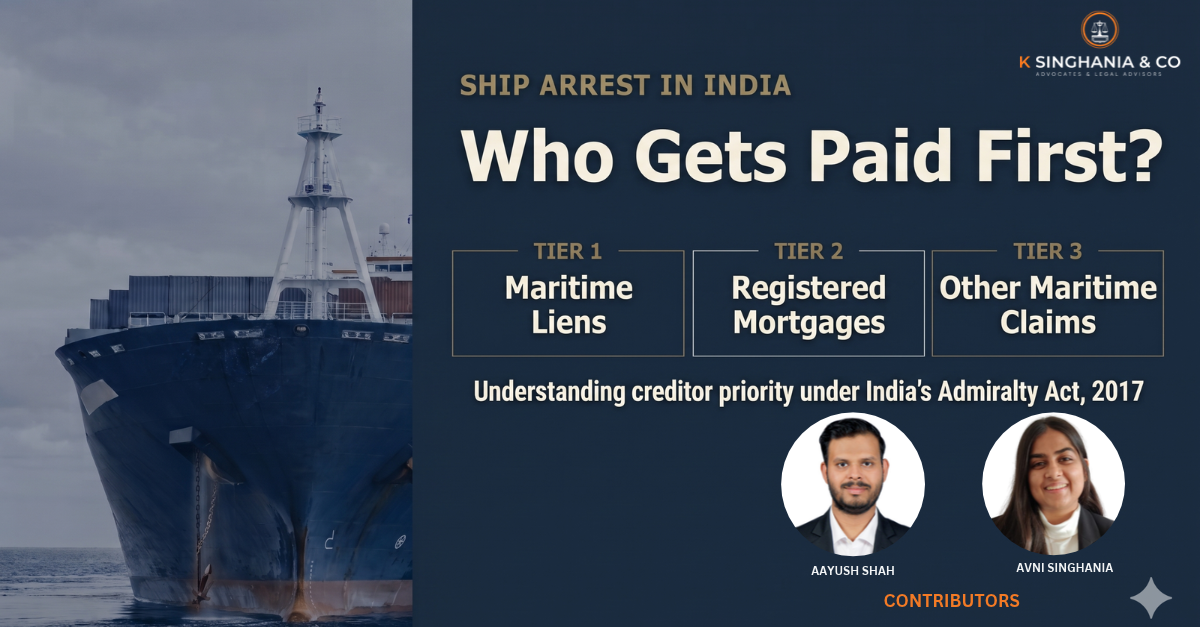
Where an arrested Indian vessel is judicially sold, Section 10 of the Admiralty (Jurisdiction and Settlement of Maritime Claims) Act, 2017 governs the priority of competing claims against the sale proceeds.
Tier 1
Maritime Liens (Section 9)
Tier 2
Registered Mortgages & Charges
Tier 3
All Other Maritime Claims (Section 4(1))
For foreign counsel, the client’s position in this three-tier chain is the single most important variable in the practical enforcement calculus.
Why Priority Matters for Foreign Maritime Counsel
An arrest is only worth pursuing where the client’s recovery position is realistic. The priority audit should precede the arrest decision, not follow it.
Strong Position
A foreign salvor holding a maritime lien under Section 9(1)(c) enjoys priority over registered mortgages and ordinary maritime claims — a strong recovery prospect.
Weak Position
A foreign bunker supplier in Tier 3 may recover a materially reduced percentage — or nothing — once Tier 1 and Tier 2 claims are satisfied from the sale proceeds.
Tier 1: Maritime Liens — Section 9(1) Inter Se Order
Section 9(1) sets a prescribed inter se priority among five lien categories. Claims within the same category generally rank equally, except salvage claims, which rank in inverse order of time — the most recent claim takes priority.
Crew Wages
Wages, repatriation costs, and social insurance contributions. Subject to a 2-year time limit from the date the sum fell due.
Personal Injury
Loss of life or personal injury arising from the operation of the vessel.
Salvage
Salvage services, including special compensation. Most recent claim ranks first.
Statutory Dues
Port, canal, waterway, pilotage, and other statutory dues payable in respect of the vessel.
Tort Claims
Loss or damage caused by operating the vessel, excluding damage to cargo and containers.
Lien Duration, Survival & Judicial Sale: Sections 8, 9(2) and 9(3)
Lien Extinguishment — Section 9(2)
Maritime liens are generally extinguished after one year, except crew wage claims under Section 9(1)(a), which survive for two years from the date the amount falls due. The statutory exception applies where the vessel is arrested before the period expires and that arrest leads to a forced sale by the High Court.
Period Commencement — Section 9(3)
For Section 9(1)(a) claims, the period runs from the claimant’s discharge from the vessel. For all other liens, it runs from when the claim arises. Any period during which the vessel remains under arrest or seizure is excluded from the calculation.
Effect of Judicial Sale — Section 8
A judicial sale by the High Court transfers the vessel to the purchaser free from all encumbrances — maritime liens, attachments, registered mortgages, and charges of the same nature. The purchaser acquires a clean title. Competing claims are then determined against the sale proceeds in accordance with Sections 9 and 10.
Tier 2 & Tier 3: Mortgages and Other Maritime Claims
 Tier 2 — Registered Mortgages & Charges
Under Section 10(1)(b), registered mortgages and charges rank behind maritime liens but ahead of all other maritime claims. Multiple claims within the same category rank equally under Section 10(2)(a), subject to the applicable framework governing secured creditors.
Tier 3 — All Other Maritime Claims (Section 4(1))
All remaining maritime claims share proceeds pari passu. This includes: bunker supply (clause (l)), cargo damage (clause (f)) where not secured by a lien, charterparty breach (clauses (g), (h)), construction and repair (clause (m)), and insurance premiums (clause (s)).
Where Foreign Creditors Typically Sit
A foreign Tier 1 claimant has a materially different enforcement calculus from a foreign Tier 3 claimant. The Tier 1 position is proximate to the proceeds; the Tier 3 position is residual.
|
Foreign Claimant |
Priority Tier |
Practical Recovery Position |
|
Foreign Crew |
Tier 1(a) |
Highest within maritime liens; typically recovers first. |
|
Foreign Salvor |
Tier 1(c) |
After wages and personal injury, before port dues and tort; strong recovery. |
|
Foreign Mortgage Lender |
Tier 2 |
Behind all liens, ahead of unsecured claims; recovery depends on residual proceeds after Tier 1. |
|
Foreign Bunker Supplier |
Tier 3 — S.4(1)(l) |
Pari passu with other Tier 3 claims; recovery depends on residual proceeds after Tiers 1 and 2. |
|
Foreign Cargo Claimant |
Tier 3 — S.4(1)(f) |
Pari passu with other Tier 3 claims. Ordinary cargo damage does not attract a maritime lien under Section 9(1)(e). |
|
Foreign Charterparty Counterparty |
Tier 3 — S.4(1)(g)/(h) |
Pari passu with other Tier 3 claims. |
K S&Co View: The Pre-Arrest Priority Audit
Before initiating Indian ship arrest, the priority position should be audited against the vessel’s known distress indicators — prior arrests, outstanding crew wages, defaulted mortgages, port dues owed, and salvage incidents.
Tier 3 Claimant Risk
A Tier 3 foreign claimant arresting a vessel that already carries Tier 1 wages or a defaulted Tier 2 mortgage faces a residual-recovery scenario that may not justify the arrest costs.
Tier 1 Claimant Caution
A foreign salvor holding a valid maritime lien may have a stronger recovery position, but the decision to pursue arrest should still account for competing higher-priority claims, the vessel’s estimated sale value, and likely enforcement costs.
FAQ: Foreign Maritime Counsel Questions
Where does a foreign bunker supplier sit in the Indian priority chain?
A foreign bunker supplier’s claim falls under Section 4(1)(l) — bunker fuel and goods or services supplied to a vessel. Such claims are maritime claims but do not ordinarily constitute maritime liens under Section 9. They fall within Tier 3, ranking behind maritime liens and registered mortgages. Recovery depends on proceeds remaining after higher-priority claims are satisfied.
Do foreign crew wages have priority over a registered foreign mortgage?
Yes. Under Section 10(1), maritime liens rank ahead of registered mortgages. Section 9(1)(a) gives crew wage claims the highest priority among maritime liens. However, under the proviso to Section 9(2), such liens are extinguished after two years from the date wages fall due, subject to the statutory exception for arrest leading to a forced sale.
Does a maritime lien survive the judicial sale of the vessel in India?
No. Under Section 8, a vessel sold by the High Court vests in the purchaser free from all encumbrances — maritime liens, attachments, registered mortgages, and charges of the same nature. Competing claims are then addressed through admiralty proceedings, subject to the priority rules under Sections 9 and 10.
Key Takeaways for Foreign Maritime Counsel
Audit First
Conduct a pre-arrest priority audit against the vessel’s known distress indicators before initiating any arrest proceedings.
Know Your Tier
The Section 10 three-tier chain — maritime liens, registered mortgages, then all other claims — determines your client’s practical recovery prospect.
Watch the Deadlines
Maritime liens are extinguished after one year (two years for crew wages). Arrest before expiry to preserve the lien and benefit from the statutory exception.
Judicial Sale is Clean
Under Section 8, judicial sale transfers the vessel free from all encumbrances. Claims migrate to the sale proceeds and are ranked per Sections 9 and 10.
K Singhania & Co · Disputes Practice · Maritime and Cross-Border Enforcement · Updated October 2026