
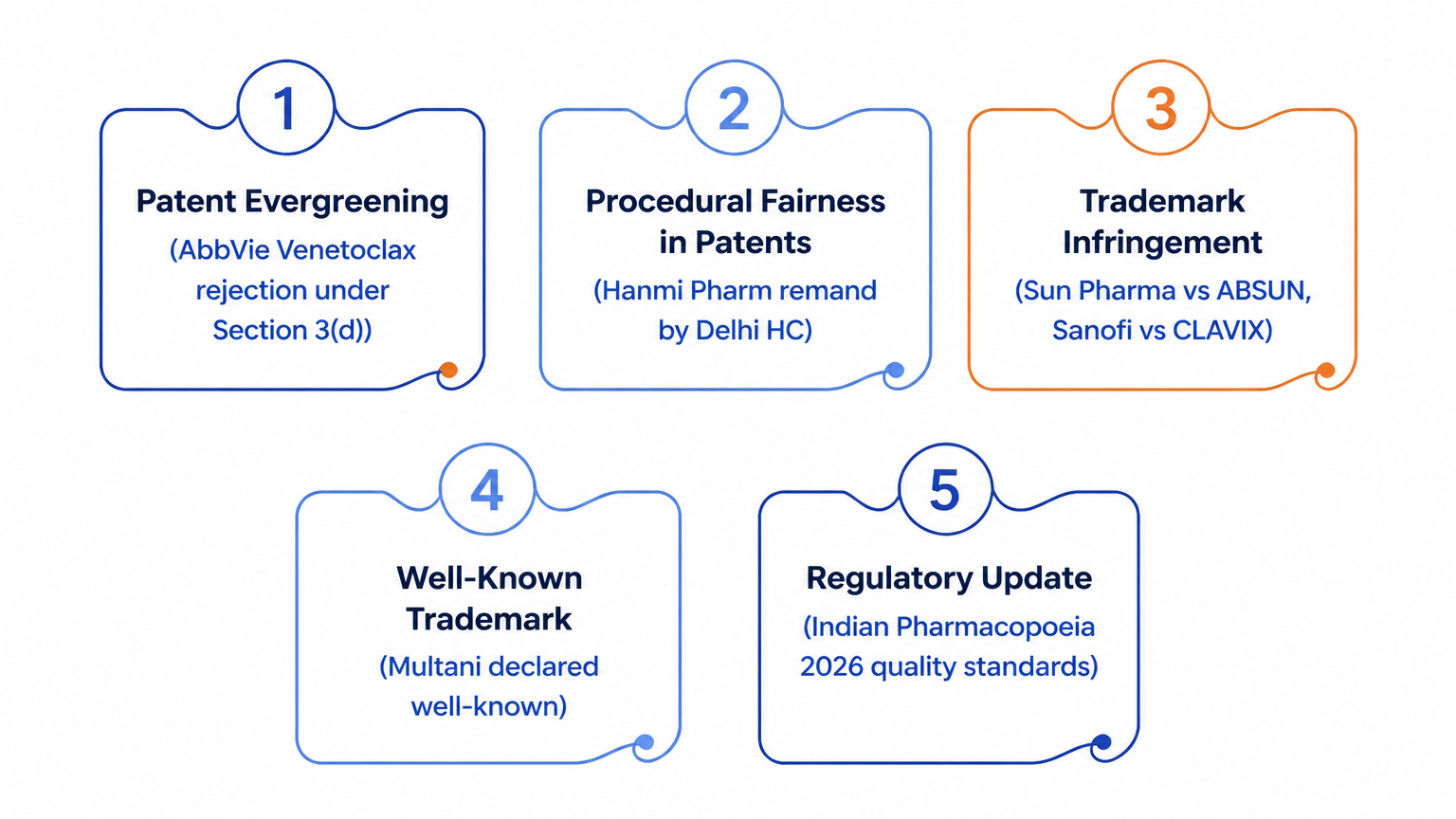
The period spanning April to June 2026 has witnessed a series of significant judicial pronouncements and regulatory developments that continue to shape the intellectual property landscape in India’s pharmaceutical and life sciences sector. Courts have engaged with pressing questions around patent evergreening, procedural fairness in patent examination, trademark similarity in the healthcare space, and the growing challenge of protecting well-known pharmaceutical brands against imitation.
Overview: Key Developments at a Glance
This newsletter provides a structured overview of the most consequential IP and regulatory developments across patents, trademarks, and drug quality standards — and analyses their implications for innovator companies, generic manufacturers, and healthcare brands operating in or entering the Indian market.
AbbVie’s Venetoclax Patent Rejected by the Indian Patent Office
Key Patent Development
Background
The Indian Patent Office (IPO) rejected a patent application filed by AbbVie for Venetoclax, a drug used in the treatment of chronic lymphocytic leukaemia and acute myeloid leukaemia, marketed in India under the brand name Venclyxto. The application attracted seven pre-grant oppositions filed between 2018 and 2025. The IPO’s Delhi office ultimately declined to grant the patent on two grounds:
- The claimed invention was obvious and lacked an inventive step
- It constituted a violation of Section 3(d) of the Indian Patents Act, 1970
Legal Framework: Section 3(d)
Section 3(d) restricts the grant of patents on new forms or derivatives of known substances unless the applicant demonstrates a significant enhancement in therapeutic efficacy. This provision is a legislative tool specifically designed to prevent the evergreening of pharmaceutical patents — the practice of seeking extended patent protection through minor modifications that do not deliver meaningful therapeutic improvements.
IPO’s Core Finding
The applicant had completely failed to establish pharmacological activity or therapeutic efficacy across the millions of compounds claimed in the application. The Office concluded this was a textbook instance of evergreening.
What’s at Stake
If AbbVie does not challenge this decision, it could pave the way for affordable generic versions of Venetoclax entering the Indian market — significantly benefiting patients requiring treatment for blood cancers.
‘Cannot Launch a Drug Without a Basic Trademark Search’: PLAVIX vs. CLAVIX
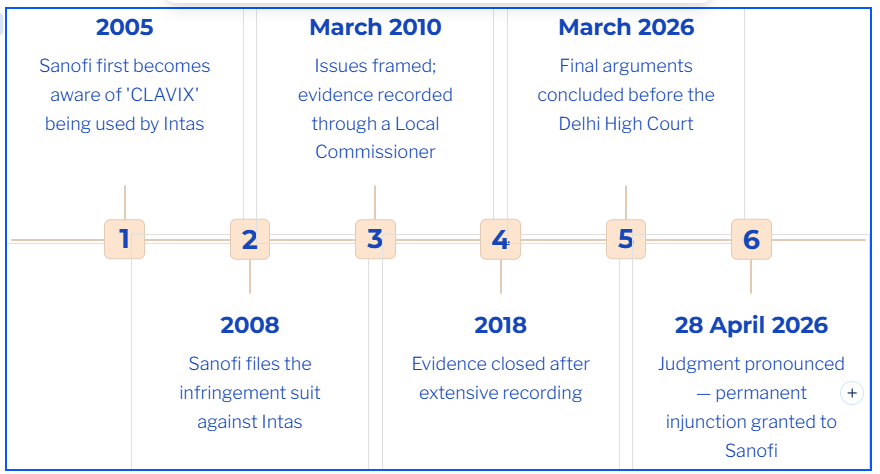
Sanofi v. Intas Pharmaceuticals Ltd. & Anr. | CS(COMM) 120/2016 | 2026:DHC:3574 | Delhi High Court
Court’s Analysis
The Delhi High Court held that ‘PLAVIX’ is a coined word with no direct meaning in any language, making it highly distinctive and entitled to strong protection. The Court observed that ‘PLAVIX’ and ‘CLAVIX’ differ by only a single letter — the substitution of ‘P’ for ‘C’ — while being used for identical therapeutic products (anti-thrombotic medicinal preparations).
The adoption of ‘CLAVIX’ was held to be dishonest. Intas’s defence under Section 34 of the Trade Marks Act — which protects continued use of a mark used in good faith prior to the plaintiff’s mark — was rejected as being unavailable to parties whose adoption was tainted by bad faith.
Outcome
- Permanent injunction restraining Intas from manufacturing, selling, or dealing in any medicinal preparations under ‘CLAVIX’ or any deceptively similar mark
- Nominal damages of ₹20 lakhs awarded to Sanofi
- Litigation costs also awarded
Court’s Sharp Observation
“A company cannot launch a drug into the market without conducting even a basic trademark search.”
Delhi High Court Declares ‘MULTANI’ a Well-Known Trademark
Multani Pharmaceuticals Limited v. Mayuri Bhupal Bhamare | CS(COMM) 934/2024 | 2026 LLBiz HC (DEL) 436
Background
Multani Pharmaceuticals Limited, a company with roots tracing back to a clinic established in Lahore in 1905 and the formal establishment of Multani Pharmacy in 1938, approached the Delhi High Court seeking a permanent injunction and a declaration that its mark ‘MULTANI’ be recognised as a well-known trademark under the Trade Marks Act, 1999.
The dispute arose when the company became aware that Mayuri Bhupal Bhamare had filed a trademark application incorporating the word ‘MULTANI’ and was allegedly using it for identical skincare and hair care products, creating a likelihood of consumer confusion.
Statutory Criteria Applied
Justice Jyoti Singh examined the factors prescribed under Sections 11(6) and 11(7) of the Trade Marks Act, 1999:
Extent of public knowledge and recognition of the mark
Duration, geographical reach, and extent of use and promotion
History of registration and successful enforcement of trademark rights
Recognition among consumers, distributors, and business circles
The ‘MULTANI’ mark enjoyed substantial goodwill and recognition among consumers of Ayurvedic and pharmaceutical products, supported by its extensive commercial presence, long-standing market reputation, and continuous use over several decades.
The Court declared ‘MULTANI’ a well-known trademark and granted a permanent injunction restraining the defendant from using the mark in relation to identical or related goods.
“GLIMET” vs “GLYZET / GLYNET”
Laboratories Griffon Pvt Ltd And Anr vs Rajiv Mukul Proprietor Of Zee. | INTERIM APPLICATION NO. 3540 OF 2022 IN COMM IP SUIT NO. 213 OF 2022 | Bombay High Court – 13th January 2026
In a significant ruling reaffirming the heightened scrutiny applicable to pharmaceutical trademarks, the Hon’ble Bombay High Court granted an injunction in favour of the plaintiff’s mark “GLIMET”, restraining the defendants from using the deceptively similar marks “GLYZET” and “GLYNET.”
Factual Background: The dispute arose in the context of anti-diabetic pharmaceutical products, a therapeutic segment where precision in drug identification is critical. The plaintiff, proprietor of the mark “GLIMET,” had been using the mark in relation to medicines for the treatment of diabetes and had built a degree of recognition in the market. The defendants had earlier given undertakings to the Court agreeing not to use marks that were deceptively similar to the plaintiff’s mark. Despite such undertakings, the defendants adopted and continued to use the marks “GLYZET” and “GLYNET,” prompting the plaintiff to initiate contempt and infringement proceedings.
Court’s Analysis: The Court undertook a phonetic, visual, and structural comparison of the marks and observed that:
- All marks shared the common prefix “GLY”, which is commonly associated with glucose-related medications.
- The suffixes “MET,” “ZET,” and “NET” were found to be phonetically similar, especially in the context of prescriptions, where handwriting or verbal communication may be unclear.
- The overall structure and cadence of the marks created a real likelihood of confusion, particularly among patients, pharmacists, and medical practitioners.
The Court placed strong reliance on established jurisprudence (including principles from Cadila Healthcare Ltd. v. Cadila Pharmaceuticals Ltd.) which mandates a stricter test in pharmaceutical trademark disputes due to the direct impact on public health.
Aggravating Factors: What made this case particularly serious was the conduct of the defendants:
- Deliberate breach of prior undertakings given to the Court;
- Evidence suggesting dishonest adoption rather than coincidental similarity;
- Continued use of the impugned marks despite being on notice.
Relief and Penalties: In light of these factors, the Hon’ble Court:
- Granted a permanent injunction restraining use of the impugned marks;
- Imposed exemplary costs of ₹50 lakhs, signalling strong judicial disapproval;
- Directed initiation of perjury proceedings, highlighting the seriousness of misleading the Court.
Legal Significance: This decision reinforces several key principles:
- Pharmaceutical trademark disputes are subject to a public interest overlay, where even minimal confusion is unacceptable;
- Courts are willing to impose punitive costs and sanctions where parties act in bad faith;
- Prior undertakings, once breached, significantly weaken a defendant’s case and invite stricter scrutiny.
Further Trademark Developments
“GLIMET” vs “GLYZET / GLYNET”
Laboratories Griffon Pvt Ltd And Anr vs Rajiv Mukul Proprietor Of Zee. | INTERIM APPLICATION NO. 3540 OF 2022 IN COMM IP SUIT NO. 213 OF 2022 | Bombay High Court – 13th January 2026
In a significant ruling reaffirming the heightened scrutiny applicable to pharmaceutical trademarks, the Hon’ble Bombay High Court granted an injunction in favour of the plaintiff’s mark “GLIMET”, restraining the defendants from using the deceptively similar marks “GLYZET” and “GLYNET.”
Factual Background: The dispute arose in the context of anti-diabetic pharmaceutical products, a therapeutic segment where precision in drug identification is critical. The plaintiff, proprietor of the mark “GLIMET,” had been using the mark in relation to medicines for the treatment of diabetes and had built a degree of recognition in the market. The defendants had earlier given undertakings to the Court agreeing not to use marks that were deceptively similar to the plaintiff’s mark. Despite such undertakings, the defendants adopted and continued to use the marks “GLYZET” and “GLYNET,” prompting the plaintiff to initiate contempt and infringement proceedings.
Court’s Analysis: The Court undertook a phonetic, visual, and structural comparison of the marks and observed that:
- All marks shared the common prefix “GLY”, which is commonly associated with glucose-related medications.
- The suffixes “MET,” “ZET,” and “NET” were found to be phonetically similar, especially in the context of prescriptions, where handwriting or verbal communication may be unclear.
- The overall structure and cadence of the marks created a real likelihood of confusion, particularly among patients, pharmacists, and medical practitioners.
The Court placed strong reliance on established jurisprudence (including principles from Cadila Healthcare Ltd. v. Cadila Pharmaceuticals Ltd.) which mandates a stricter test in pharmaceutical trademark disputes due to the direct impact on public health.
Aggravating Factors: What made this case particularly serious was the conduct of the defendants:
- Deliberate breach of prior undertakings given to the Court;
- Evidence suggesting dishonest adoption rather than coincidental similarity;
- Continued use of the impugned marks despite being on notice.
Relief and Penalties: In light of these factors, the Hon’ble Court:
- Granted a permanent injunction restraining use of the impugned marks;
- Imposed exemplary costs of ₹50 lakhs, signalling strong judicial disapproval;
- Directed initiation of perjury proceedings, highlighting the seriousness of misleading the Court.
Legal Significance: This decision reinforces several key principles:
- Pharmaceutical trademark disputes are subject to a public interest overlay, where even minimal confusion is unacceptable;
- Courts are willing to impose punitive costs and sanctions where parties act in bad faith;
- Prior undertakings, once breached, significantly weaken a defendant’s case and invite stricter scrutiny.