Key Indian IP cases from Oct–Nov 2025, including smell marks, AI deepfakes, well-known brands and patent procedure, with practical commentary for rights owners.
Most IP owners only hear about big judgments after the fact.
By then, it’s usually a story about someone else’s problem — a copied brand, a hijacked celebrity face, a rejected patent.
But the real value of these decisions is what they quietly signal:
“If you don’t adapt, this could be you next year.”
In October–November 2025, Indian courts and the Trade Marks Registry sent five very clear messages to brand owners, content creators and in-house legal teams.
Let’s walk through them — and after each, you’ll see K Singhania & Co’s comment on what it means in practice and how to get ahead of the curve.
1. Thinking Trademarks Are Only About Words & Logos
Until now, most Indian brand owners treated “trademark” as logo + name.
 Then came India’s first smell mark — a floral fragrance/smell reminiscent of roses applied to tyres by a Japanese company, Sumitomo Rubber Industries — formally accepted by the Trade Marks Registry on 21st November 2025.
This sits alongside existing protection for shapes and trade dress (like distinctive bottles, jars, packaging), and recent enforcement around product designs and packaging “look and feel”.
What happened recently :
- A rose-scented tyre got past the long-standing hurdles of “graphical representation” and “distinctiveness”, opening the door for olfactory trade mark registration in India.
- Courts continued to protect shape, packaging and trade dress, not just names — e.g. distinctive jars, bottles, footwear designs and get-ups, where consumers recognise the “look” as strongly as the name.
- The Hon’ble Delhi High Court, while addressing design piracy dispute (like unique slipper or footwear shape) in the case of Aqualite Industries Pvt Ltd. vs Relaxo Footwears Ltd. (2025 SCC OnLine Del 8649) upheld an injunction against Aqualite from manufacturing and selling slippers that mirror the Relaxo’s side-ridged slipper design of a Bahamas series of Hawai footwear BHG 136 and BHG 137.
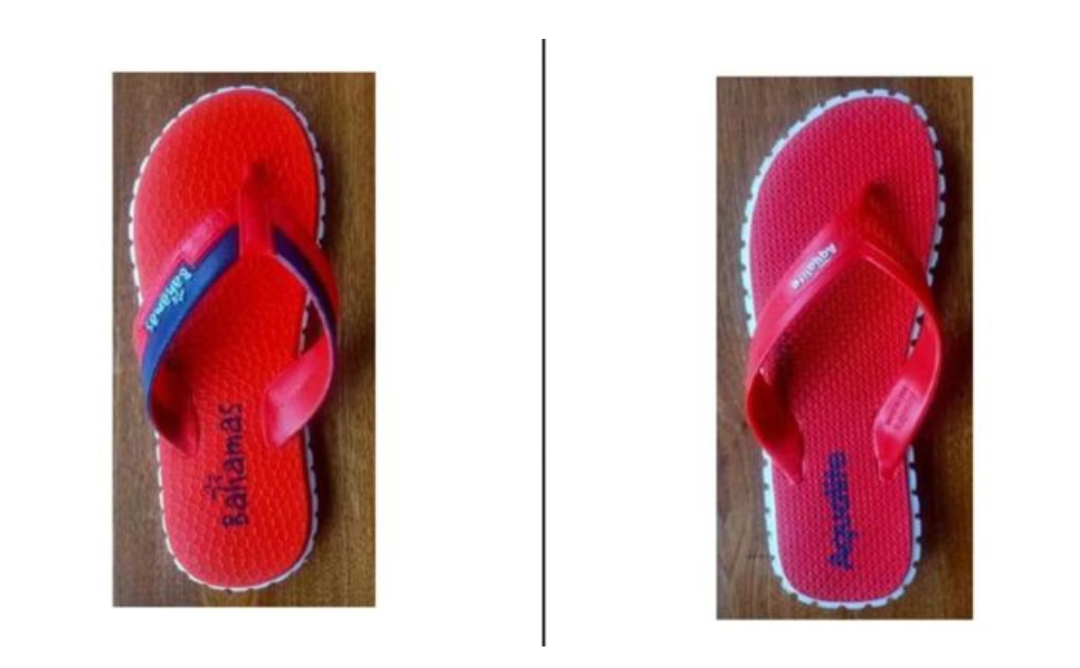 The Delhi High Court considered the rectangular “crenellation-shaped” ridges design of Relaxo as an object of novelty over the saw like structure of Aqualite. The High Court referred to the principle of the “instructed eye” wherein the perspective of a person who is ‘skilled in the art’ was preferred over the point of view of a person of ‘average intelligence and imperfect recollection’ for identifying a design to be considered as a novelty. The instructed eye who is aware of the novel features of prior art would be much better equipped to access as to whether the suit design is novel vis-à-vis prior art. Thus, with design validity established and copying evident, the Court dismissed Aqualite’s appeal, formally recognising that even the unassuming Hawai chappal can carry a legally protectable artistic signature.
What this means for you
If your product is experienced through sight, shape or smell, you may be sitting on protectable IP you’ve never documented:
- A signature bottle or jar shape
- A unique packaging layout / colour combination
- A consistent in-store scent or product fragrance
Practical next steps
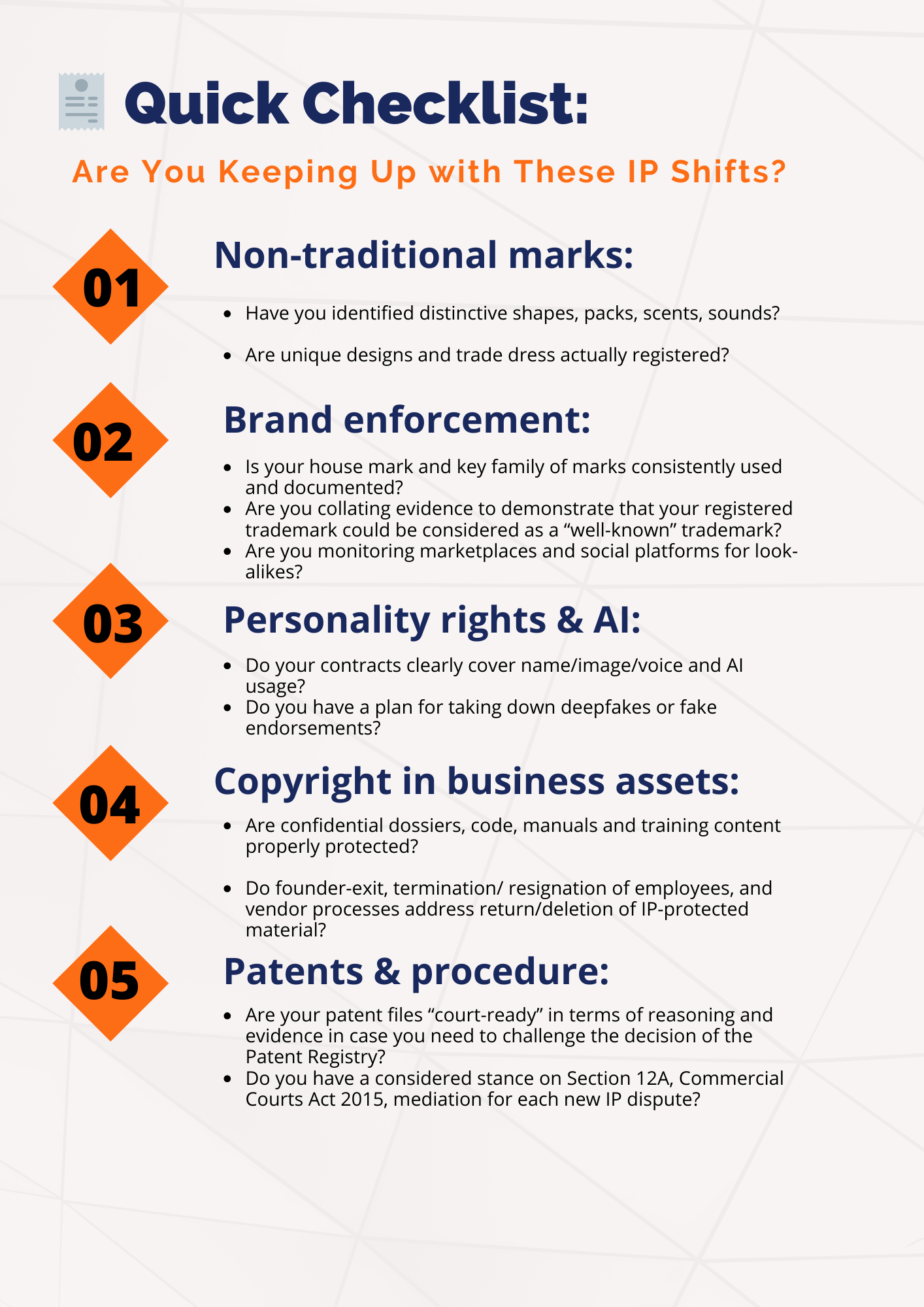
- Audit non-traditional brand assets: shapes, packs, scents, sounds.
- Register key shapes/designs early; consider whether any “signature scent/shape or design” could be framed for future protection.
- Build internal discipline: brand and product teams should treat every sensory element as potential IP, not mere marketing flair.
Our Comment :
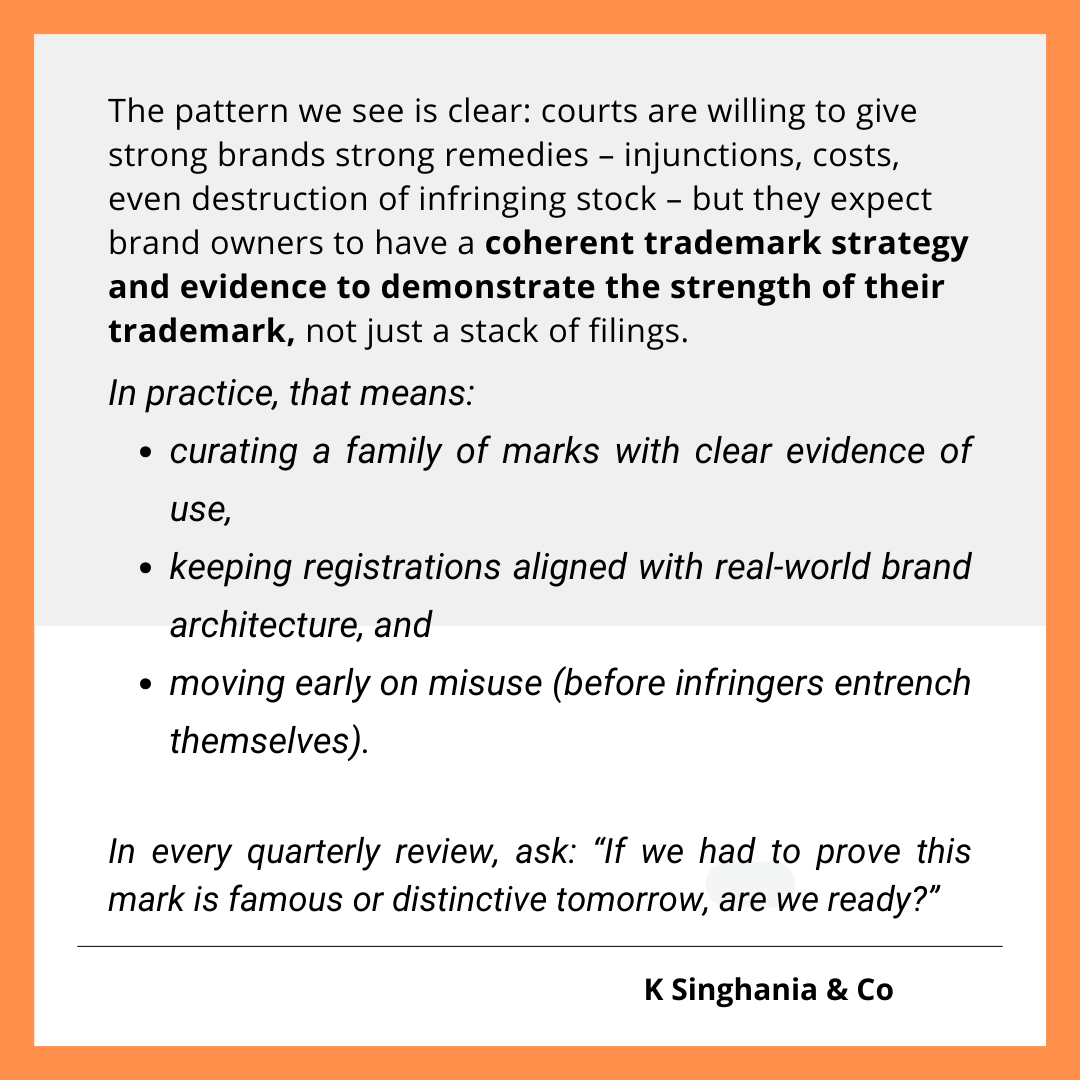
2. Underestimating How Aggressively Courts Protect Strong Brands
Recent trademark judgments underline a simple truth: if your mark is strong, the courts will back you — but only if you’ve done your homework.
What we saw in Oct–Nov 2025:
 Food & beverage: the Hon’ble Delhi High Court in the case of Wow Momo Foods Private Limited vs Wow Burger and Anr. (CS(COMM) 1161/2024 & I.A. 48983-48984/2024), restrained the use of “WOW BURGER” as deceptively similar to the established “WOW! MOMO / WOW! BURGER / WOW!” family of marks, relying on the test that confusion will be caused amongst the average consumers with imperfect recollection.
- Pharma & health: The Hon’ble Delhi High Court continued to clamp down on confusingly similar formative marks, especially where a well-known element (like a “KIND” suffix) signifies a big pharma house as seen in the case of Mankind Pharma Ltd. Vs Registrar, Trade Marks C.A.(COMM.IPD-TM) 54/2024.
- Telecom & tech: marks like JIO and WIPRO were recognised/affirmed as well-known, strengthening dilution and enforcement arguments even outside their core goods/services as seen in the cases of Reliance Industries Ltd. vs Asif Ahmed & Ors. (Interim Application (L) No. 28031 of 2025 in Commercial IP Suit (L) No. 27370 of 2025) and WIPRO Enterprises Pvt Ltd. vs Shivam Udhyog & Anr. , (2025 SCC OnLine Del 6427) respectively.
- Defences & procedure:
- Courts reiterated that you generally cannot sue a registered proprietor for infringement – you must challenge their registration instead as pronounced by the Hon’ble Delhi High Court in the case of Abros Sports International Pvt Ltd. vs Ashish Bansal & Ors. (FAO(OS) (COMM) 140/2024 & CM APPL. 38801/2024).
- In other cases, registered proprietors successfully invoked statutory defences to resist injunctions, reminding everyone that registration plus thoughtful use can be a powerful shield.
What this means for you
If you have:
- a distinctive house mark, or
- a family of series / formative marks across product lines,
you should be actively:
- consolidating registrations (core + adjacent classes),
- tracking misuse (even on social media and marketplaces), and
- using your marks in a way that supports future “well-known” status or statutory defences.
Practical next steps
- Map your brand architecture: house mark, sub-brands, formative marks, taglines.
- Identify candidates for “well-known mark” strategy and start building the evidentiary record (use, publicity, sales, enforcement).
- Audit who holds which registrations (old distributors, JV entities, ex-partners) and clean up legacy filings that might block enforcement later.
Our Comment
3.Treating Personality Rights as an important IP asset not just for celebrities
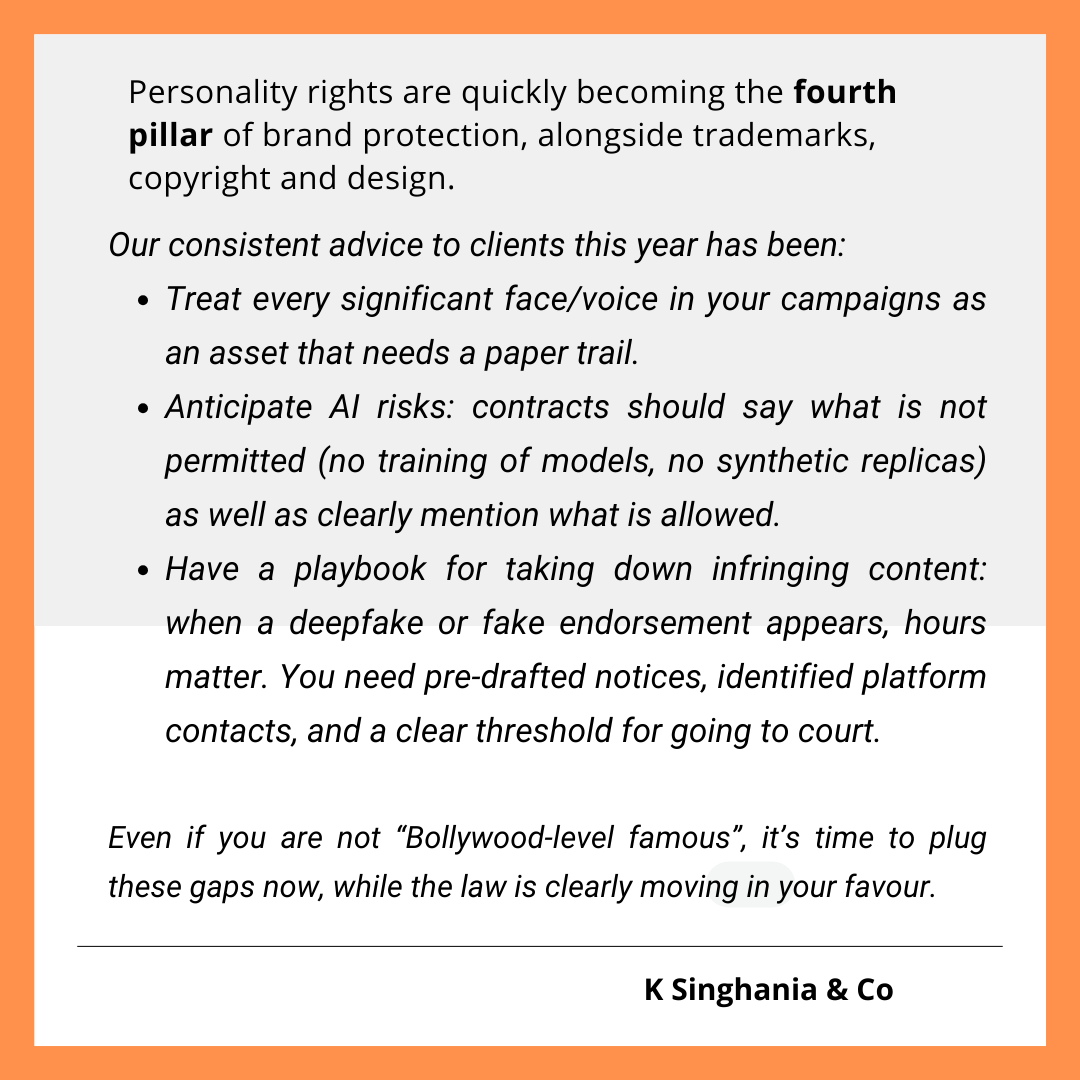
In 2025, personality-rights law in India went from niche to mainstream.
October–November saw a series of cases where courts intervened against AI voice cloning, deepfake videos, and unauthorised use of names and images:
- Asha Bhosle v. Mayc Inc (Bombay HC) 2025 SCC OnLine Bom 3485– ad-interim protection against platforms prohibiting AI voice-cloning of the singer, and commercial exploitation of her image/likeness without consent.

- Multiple “John Doe” suits filed by actors and public figures such as Mr. Suniel Shetty (in the case of Suniel V Shetty vs. John Doe S Ashok Kumar 2025 SCC OnLine Bom 3918), Mr. Akshay Hari Om Bhatia (in the case of Akshay Hari Om Bhatia vs. John Doe. 2025 SCC OnLine Bom 4044) and Mr. Hrithik Roshan (in the case of Hrithik Roshan vs. Ashok Kumar / John Doe & Ors. CS(COMM) 1107/2025 & I.A. 25665-25667/2025) seeking orders to remove deepfakes, AI-altered images and unauthorised endorsements.
- Dr. Ilaiyaraaja vs John Doe Ashok Kumar, and Others (Madras HC) 2025 SCC OnLine Mad 10521 – interim orders restraining the use of his name, image, voice and AI-generated likeness across social media and video platforms, with takedown directions to intermediaries.
This is not just about film stars. Anyone with a recognisable persona — founders, influencers, spiritual leaders, domain experts — is now exposed.
What this means for you
If your business relies on people as part of the brand — founders in marketing, influencer campaigns, key opinion leaders — you now need a personality rights strategy, along with an IP one.
Key risks:
- AI tools cloning voices or faces without consent
- Fake endorsements using your executives’ images or names
- Deepfake “interviews” or reels that damage reputation
Practical next steps
- Update contract templates with explicit personality rights clauses (name, image, likeness, voice, AI use).
- Put in place a monitoring and takedown protocol – who scans platforms, who sends notices, when to escalate to court.
- Internally, decide who owns what: Does the company own the right to use a founder’s image beyond their tenure? For what purposes? For how long?
Our Comment
4. Seeing Copyright as “Not Only for Songs and Movies”
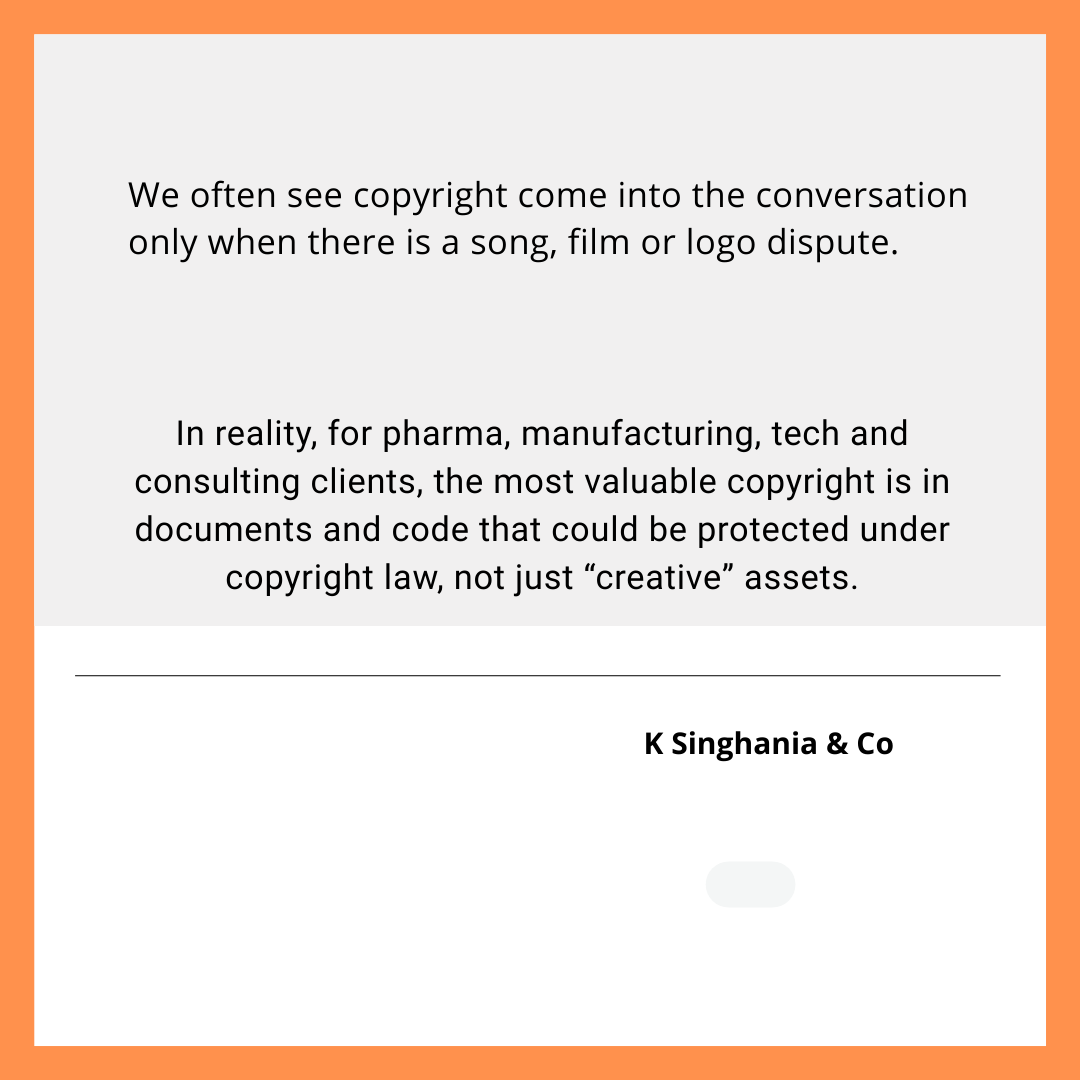
The October–November matters remind us that copyright law is not limited to artistic or musical works:
- In the case of Saregama India Ltd. vs En.SsYoutube & Ors. (CS(COMM) 1191/2025), the Hon’ble Delhi High Court cracked down on stream-ripping and illegal music download/streaming sites, granting blocking orders and reinforcing that digital piracy will attract serious relief.

- In other disputes, The Hon’ble Allahabad High Court in the case of Jamp India Pharmaceuticals Private vs Jubilant Generics Ltd & Ors. 2025 SCC OnLine All 6898
- Film and TV-related cases saw courts restrain reuse of scenes, background scores and other elements without proper licensing, even at an interim stage.
What this means for you
Most businesses underestimate how much of their day-to-day output may be copyright-protected:
- Product manuals
- Regulatory dossiers
- Technical drawings and SOPs
- Training material and internal decks
- Web copy, creative campaigns, UI elements
Losing control of these — especially to ex-employees, vendors or competitors — can be as damaging as losing a registered IP right.
Practical next steps
- Classify key document types by sensitivity (high/medium/low) and ensure clear ownership and confidentiality language in contracts.
- For anything shared with distributors, vendors, franchisees or consultants, ensure use is strictly defined and survives termination only where intended.
- Treat piracy and unauthorised uploads (music, films, training videos) as a continuous enforcement task, not a one-off lawsuit.
Our Comment:
5. Treating Procedure not just as a technicality but a strategic step in IP Litigation & Patents Registration
Two strands stood out in late-2025:
1. Supreme Court on pre-litigation mediation (Section 12A of the Commercial Courts Act, 2015)
-
- In Novenco Building & Industry A/S v. Xero Energy Engineering Solutions Pvt Ltd. & Anr. (2025 INSC 1256), the Supreme Court clarified when IP owners can bypass mandatory pre-institution mediation under the Commercial Courts Act — especially where urgent interim relief exception is genuinely required in ongoing infringement situations.
2. Patent Office decisions under closer judicial scrutiny
-
- The Hon’ble Delhi High Court, The Hon’ble Madras High Court have continued to remand patent refusals back to the Patent Office where orders were non-speaking, mechanically reasoned or procedurally deficient (for example, ignoring key submissions on inventive step or ethical bars).
- At the same time, courts upheld refusals in sensitive areas (like human embryo-related inventions), emphasising ethical limitations on what can be patented.
What this means for you
Procedure is no longer a box-ticking exercise:
- For patent applicants, sloppy prosecution (or vague orders) can and will be challenged — but you need a clear record of what you argued, what was ignored, and why it matters.
- For IP litigants, you can’t assume Section 12A is a rubber stamp. You must show why mediation is inappropriate where urgent relief is needed — or be ready to mediate where it’s not.
Practical next steps
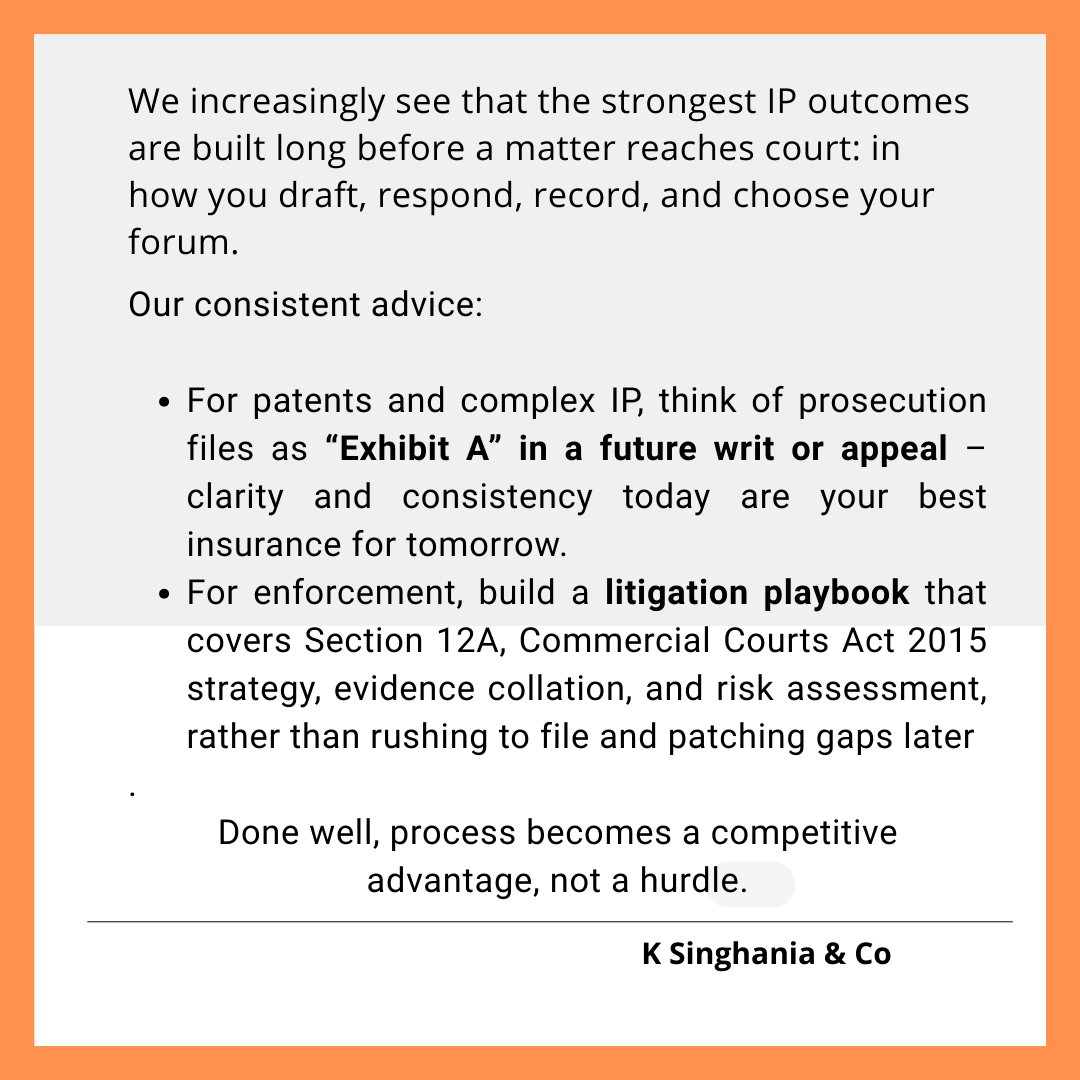
- Align your patent strategy with litigation strategy from day one: draft specifications and responses with a view that how a High Court will read them if things go wrong. Treat each office action and hearing as part of a potential future court record, not a casual back-and-forth with the registry.
- Before filing an infringement suit, document the urgency in the case: ongoing harm, risk of evidence destruction, market impact — this will matter when the court weighs Section 12A compliance.
Our Comment